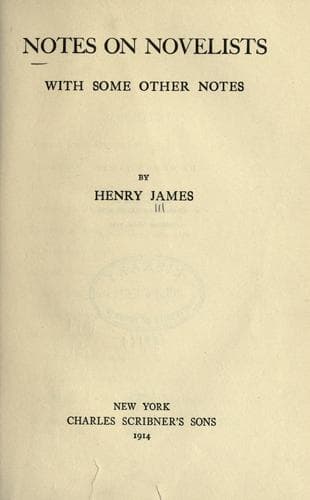
Notes on Novelists, with Some Other NotesJames, Henry
History
Notes on Novelists, with Some Other Notes
James, Henry
Fiction -- History and criticism; Novelists
quarters scarce even suspect and at some of which it will presently be
of profit to glance. “I answer for it, you know,” we seem at any rate to
hear Mr. Gilbert Cannan say with an admirably genuine young pessimism,
“I answer for it that they were really _like_ that, odd or unpleasant or
uncontributive, and therefore tiresome, as it may strike you;” and the
charm of Mr. Cannan, so far as up or down the rank we so disengage a
charm, is that we take him at his word. His guarantee, his straight
communication, of his general truth is a value, and values are rare—the
flood of fiction is apparently capable of running hundreds of miles
without a single glint of one—and thus in default of satisfaction we
get stopgaps and are thankful often under a genial touch to get even so
much. The value indeed is crude, it would be quadrupled were it only
wrought and shaped; yet it has still the rude dignity that it counts to
us for experience or at least for what we call under our present pitch
of sensibility force of impression. The experience, we feel, is ever
something to conclude upon, while the impression is content to wait; to
wait, say, in the spirit in which we must accept this younger bustle if
we accept it at all, the spirit of its serving as a rather presumptuous
lesson to us in patience. While we wait, again, we are amused—not in
the least, also to repeat, up to the notch of our conception of
amusement, which draws upon still other forms and sources; but none the
less for the wonder, the intensity, the actuality, the probity of the
vision. This is much as in “Clayhanger” and in “Hilda Lessways,” where,
independently of the effect, so considerably rendered, of the long lapse
of time, always in this type of recital a source of amusement in itself,
and certainly of the noblest, we get such an admirably substantial thing
as the collective image of the Orgreaves, the local family in whose
ample lap the amenities and the humanities so easily sit, for Mr.
Bennett’s evocation and his protagonist’s recognition, and the manner of
the presentation of whom, with the function and relation of the picture
at large, strikes such a note of felicity, achieves such a simulation of
sense, as the author should never again be excused for treating, that is
for neglecting, as beyond his range. Here figures signally the
interesting case of a compositional function absolutely performed by
mere multiplication, the flow of the facts: the Orgreaves, in
“Clayhanger,” are there, by what we make out, but for “life,” for
general life only, and yet, with their office under any general or
inferential meaning entirely unmarked, come doubtless as near squaring
esthetically with the famous formula of the “slice of life” as any
example that could be adduced; happening moreover as they probably do to
owe this distinction to their coincidence at once with reality and
charm—a fact esthetically curious and delightful. For we attribute the
bold stroke they represent much more to Mr.
Public-domain text, read in full here on John Shaqi.
Reviews
Reviews
No reviews yet
Be the first to share your thoughts on this work.
Elsewhere in the archive
Join the Discussion
Join the discussion
Sign in to leave a comment or review.
Sign InorCreate an account