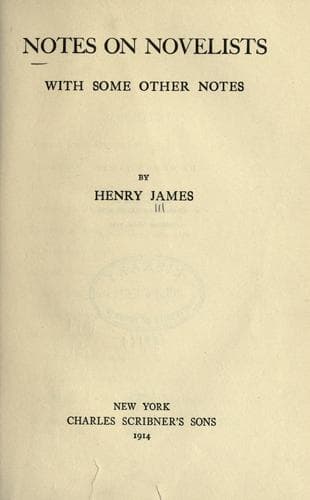
Notes on Novelists, with Some Other NotesJames, Henry
History
Notes on Novelists, with Some Other Notes
James, Henry
Fiction -- History and criticism; Novelists
The exception we speak of would be Mrs. Wharton’s “Custom of the
Country,” in which, as in this lady’s other fictions, we recognise the
happy fact of an abuse of no one of the resources it enjoys at the
expense of the others; the whole series offering as general an example
of dialogue flowering and not weeding, illustrational and not itself
starved of illustration, or starved of referability and association,
which is the same thing, as meets the eye in any glance that leaves Mr.
Wells at Mr. Wells’s best-inspired hour out of our own account. The
truth is, however, that Mrs. Wharton is herself here out of our account,
even as we have easily recognised Mr. Galsworthy and Mr. Maurice Hewlett
to be; these three authors, with whatever differences between them,
remaining essentially votaries of selection and intention and being
embodiments thereby, in each case, of some state over and above that
simple state of possession of much evidence, that confused conception of
what the “slice” of life must consist of, which forms the text of our
remarks. Mrs. Wharton, _her_ conception of the “slice” so clarified and
cultivated, would herself of course form a text in quite another
connection, as Mr. Hewlett and Mr. Galsworthy would do each in his own,
which we abstain from specifying; but there are two or three grounds on
which the author of “Ethan Frome,” “The Valley of Decision” and “The
House of Mirth,” whom we brush by with reluctance, would point the moral
of the treasure of amusement sitting in the lap of method with a
felicity peculiarly her own. If one of these is that she too has clearly
a saturation—which it would be ever so interesting to determine and
appreciate—we have it from her not in the crude state but in the
extract, the extract that makes all the difference for our sense of an
artistic economy. If the extract, as would appear, is the result of an
artistic economy, as the latter is its logical motive, so we find it
associated in Mrs. Wharton with such appeals to our interest, for
instance, as the fact that, absolutely sole among our students of this
form, she suffers, she even encourages, her expression to flower into
some sharp image or figure of her thought when that will make the
thought more finely touch us. Her step, without straying, encounters the
living analogy, which she gathers, in passing, without awkwardness of
pause, and which the page then carries on its breast as a trophy plucked
by a happy adventurous dash, a token of spirit and temper as well as a
proof of vision. We note it as one of the _kinds_ of proof of vision
that most fail us in that comparative desert of the inselective where
our imagination has itself to hunt out or call down (often among strange
witnessed flounderings or sand-storms) such analogies as may mercifully
“put” the thing. Mrs. Wharton not only owes to her cultivated art of
putting it the distinction enjoyed when some ideal of expression has the
Public-domain text, read in full here on John Shaqi.
Reviews
Reviews
No reviews yet
Be the first to share your thoughts on this work.
Elsewhere in the archive
Join the Discussion
Join the discussion
Sign in to leave a comment or review.
Sign InorCreate an account