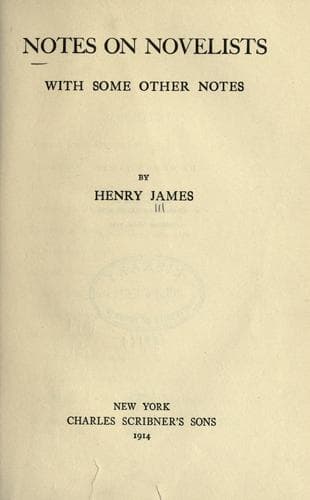
Notes on Novelists, with Some Other NotesJames, Henry
History
Notes on Novelists, with Some Other Notes
James, Henry
Fiction -- History and criticism; Novelists
_whole_ of the case, the case once made its concern, in charge, but
might further act for us, were we to follow up her exhibition, as
lighting not a little that question of “tone,” the author’s own
intrinsic, as to which we have just seen Mr. Conrad’s late production
rather tend to darken counsel. “The Custom of the Country” is an eminent
instance of the sort of tonic value most opposed to that baffled
relation between the subject-matter and its emergence which we find
constituted by the circumvalations of “Chance.” Mrs. Wharton’s reaction
in presence of the aspects of life hitherto, it would seem, mainly
exposed to her is for the most part the ironic—to which we gather that
these particular aspects have so much ministered that, were we to pursue
the quest, we might recognise in them precisely the saturation as to
which we a moment ago reserved our judgment. “The Custom of the Country”
is at any rate consistently, almost scientifically satiric, as indeed
the satiric light was doubtless the only one in which the elements
engaged could at all be focussed together. But this happens directly to
the profit of something that, as we read, becomes more and more one with
the principle of authority at work; the light that gathers is a dry
light, of great intensity, and the effect, if not rather the very
essence, of its dryness is a particular fine asperity. The usual
“creative” conditions and associations, as we have elsewhere languished
among them, are thanks to this ever so sensibly altered; the general
authoritative relation attested becomes clear—we move in an air purged
at a stroke of the old sentimental and romantic values, the perversions
with the maximum of waste of perversions, and we shall not here attempt
to state what this makes for in the way of esthetic refreshment and
relief; the waste having kept us so dangling on the dark esthetic abyss.
A shade of asperity may be in such fashion a security against waste, and
in the dearth of displayed securities we should welcome it on that
ground alone. It helps at any rate to constitute for the talent manifest
in “The Custom” a rare identity, so far should we have to go to seek
another instance of the dry, or call it perhaps even the hard,
intellectual touch in the soft, or call it perhaps even the humid,
temperamental air; in other words of the masculine conclusion tending so
to crown the feminine observation.
Public-domain text, read in full here on John Shaqi.
Reviews
Reviews
No reviews yet
Be the first to share your thoughts on this work.
Elsewhere in the archive
Join the Discussion
Join the discussion
Sign in to leave a comment or review.
Sign InorCreate an account