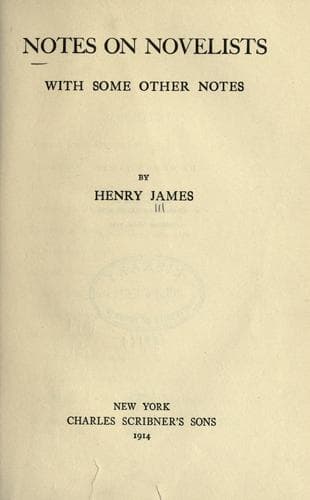
Notes on Novelists, with Some Other NotesJames, Henry
History
Notes on Novelists, with Some Other Notes
James, Henry
Fiction -- History and criticism; Novelists
If we mentioned Mr. Compton Mackenzie at the beginning of these
reflections only to leave him waiting for some further appreciation,
this is exactly because his case, to the most interesting effect, is no
simple one, like two or three of our others, but on the contrary
mystifying enough almost to stand by itself. What would be this striking
young writer’s state of acquaintance and possession, and should we find
it, on our recognition of it, to be all he is content to pitch forth,
without discriminations or determinants, without motives or lights? Do
“Carnival” and “Sinister Street” proceed from the theory of the slice or
from the conception of the extract, “the extract flasked and fine,” the
chemical process superseding the mechanical? Mr. Compton Mackenzie’s
literary aspect, though decidedly that of youth, or that of experience,
a great deal of young experience, in its freshness, offers the
attraction of a complexity defiant of the prompt conclusion, really
charms us by giving us something to wonder about. We literally find it
not easy to say if there may not lurk in “Carnival,” for example, a
selective sense more apprehensible, to a push of inquiry, than its
overflooded surface, a real invitation to wade and upon which everything
within the author’s ken appears poured out, would at first lead us to
suspect. The question comes up in like fashion as to the distinctly more
developed successor of that work, before which we in fact find questions
multiply to a positive quickening of critical pleasure. We ask ourselves
what “Sinister Street” may mean as a whole in spite of our sense of
being brushed from the first by a hundred subordinate purposes, the
succession and alternation of which seem to make after a fashion a plan,
and which, though full of occasional design, yet fail to gather
themselves for application or to converge to an idea. Any idea will
serve, ever, that has held up its candle to composition—and it is
perhaps because composition proposes itself under Mr. Compton
Mackenzie’s energy on a scale well-nigh of the most prodigious that we
must wait to see whither it tends. The question of what he may here mean
“on the whole,” as we just said, is doubtless admonished to stand back
till we be possessed of the whole. This interesting volume is but a
first, committed up to its eyes to continuity and with an announced
sequel to follow. The recital exhibits at the point we have reached the
intimate experience of a boy at school and in his holidays, the
amplification of which is to come with his terms and their breaks at a
university; and the record will probably form a more squared and
extended picture of life equally conditioned by the extremity of youth
than we shall know where else to look for. Youth clearly has been Mr.
Mackenzie’s saturation, as it has been Mr. Hugh Walpole’s, but we see
this not as a subject (youth in itself is no specific subject, any more
than age is,) but as matter for a subject and as requiring a motive to
Public-domain text, read in full here on John Shaqi.
Reviews
Reviews
No reviews yet
Be the first to share your thoughts on this work.
Elsewhere in the archive
Join the Discussion
Join the discussion
Sign in to leave a comment or review.
Sign InorCreate an account