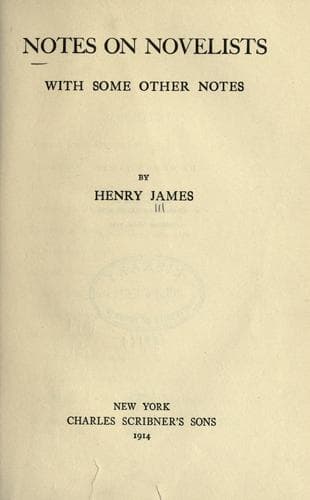
Notes on Novelists, with Some Other NotesJames, Henry
History
Notes on Novelists, with Some Other Notes
James, Henry
Fiction -- History and criticism; Novelists
I welcomed the general impression at all events—I intimately
entertained it; it represented so many things, it suggested, just as it
was, such a lesson. You could neither have everything nor be
everything—you had to choose; you could not at once sit firm at your
job and wander through space inviting initiations. The author of Les
Rougon-Macquart had had all those, certainly, that this wonderful
company could bring him; but I can scarce express how it was implied in
him that his time had been fruitfully passed with _them_ alone. His
artistic evolution struck one thus as, in spite of its magnitude,
singularly simple, and evidence of the simplicity seems further offered
by his last production, of which we have just come into possession.
“Vérité” truly does give the measure, makes the author’s high maturity
join hands with his youth, marks the rigid straightness of his course
from point to point. He had seen his horizon and his fixed goal from the
first, and no cross-scent, no new distance, no blue gap in the hills to
right or to left ever tempted him to stray. “Vérité,” of which I shall
have more to say, is in fact, as a moral finality and the crown of an
edifice, one of the strangest possible performances. Machine-minted and
made good by an immense expertness, it yet makes us ask how, for
disinterested observation and perception, the writer had used so much
time and so much acquisition, and how he can all along have handled so
much material without some larger subjective consequence. We really rub
our eyes in other words to see so great an intellectual adventure as Les
Rougon-Macquart come to its end in deep desert sand. Difficult truly to
read, because showing him at last almost completely a prey to the danger
that had for a long time more and more dogged his steps, the danger of
the mechanical all confident and triumphant, the book is nevertheless
full of interest for a reader desirous to penetrate. It speaks with more
distinctness of the author’s temperament, tone and manner than if, like
several of his volumes, it achieved or enjoyed a successful life of its
own. Its heavy completeness, with all this, as of some prodigiously
neat, strong and complicated scaffolding constructed by a firm of
builders for the erection of a house whose foundations refuse to bear it
and that is unable therefore to rise—its very betrayal of a method and
a habit more than adequate, on past occasions, to similar ends, carries
us back to the original rare exhibition, the grand assurance and grand
patience with which the system was launched.
Public-domain text, read in full here on John Shaqi.
Reviews
Reviews
No reviews yet
Be the first to share your thoughts on this work.
Join the Discussion
Join the discussion
Sign in to leave a comment or review.
Sign InorCreate an account