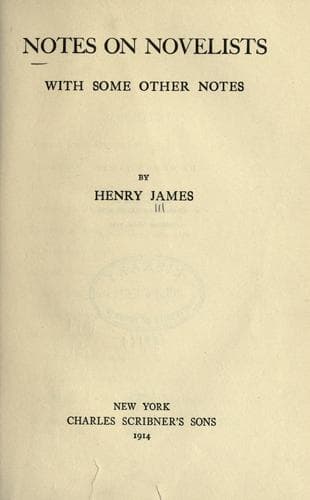
Notes on Novelists, with Some Other NotesJames, Henry
History
Notes on Novelists, with Some Other Notes
James, Henry
Fiction -- History and criticism; Novelists
redeem it from the merely passive state of the slice. We are sure
throughout both “Sinister Street” and “Carnival” of breathing the air of
the extract, as we contentiously call it, only in certain of the rounded
episodes strung on the loose cord as so many vivid beads, each of its
chosen hue, and the series of which, even with differences of price
between them, we take for a lively gage of performance to come. These
episodes would be easy to cite; they are handsomely numerous and each
strikes us as giving in its turn great salience to its motive; besides
which each is in its turn “done” with an eminent sense and a remarkably
straight hand for doing. They may well be cited together as both
signally and finely symptomatic, for the literary gesture and the
_bravura_ breadth with which such frequent medallions as the adventure
on the boy’s part of the Catholic church at Bournemouth, as his
experiment of the Benedictine house in Wiltshire, as his period of
acquaintance with the esthetic _cénacle_ in London, as his relation with
his chosen school friend under the intensity of boyish choosing, are
ornamentally hung up, differ not so much in degree as in kind from any
play of presentation that we mostly see elsewhere offered us. To which
we might add other like matters that we lack space to enumerate, the
scene, the aspect, the figure in motion tending always, under touches
thick and strong, to emerge and flush, sound and strike, catch us in its
truth. We have read “tales of school life” in which the boys more or
less swarmed and sounded, but from which the masters have practically
been quite absent, to the great weakening of any picture of the boyish
consciousness, on which the magisterial fact is so heavily projected. If
that is less true for some boys than for others, the “point” of Michael
Fane is that for him it is truest. The types of masters have in
“Sinister Street” both number and salience, rendered though they be
mostly as grotesques—which effect we take as characterising the
particular turn of mind of the young observer and discoverer
commemorated.
Public-domain text, read in full here on John Shaqi.
Reviews
Reviews
No reviews yet
Be the first to share your thoughts on this work.
Elsewhere in the archive
Join the Discussion
Join the discussion
Sign in to leave a comment or review.
Sign InorCreate an account