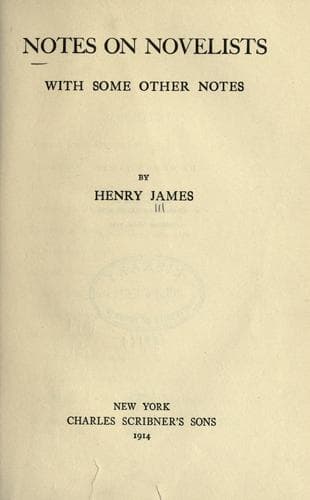
Notes on Novelists, with Some Other NotesJames, Henry
History
Notes on Novelists, with Some Other Notes
James, Henry
Fiction -- History and criticism; Novelists
That he _is_ a discoverer is of the essence of his interest, a
successful and resourceful young discoverer, even as the poor
ballet-girl in “Carnival” is a tragically baffled and helpless one; so
that what each of the works proposes to itself is a recital of the
things discovered. Those thus brought to our view in the boy’s case are
of much more interest, to our sense, than like matters in the other
connection, thanks to his remarkable and living capacity; the heroine of
“Carnival” is frankly too minute a vessel of experience for treatment on
the scale on which the author has honoured her—she is done assuredly,
but under multiplications of touch that become too much, in the narrow
field, monotonies; and she leaves us asking almost as much what she
exhibitionally means, what application resides in the accumulation of
facts concerning her, as if she too were after all but a slice, or at
the most but a slice _of_ a slice, and her history but one of the
aspects, on her author’s part, of the condition of repleteness against
the postulate of the entire adequacy of which we protest. So far as this
record does affect us as an achieved “extract,” to reiterate our term,
that result abides in its not losing its centre, which is its fidelity
to the one question of her dolefully embarrassed little measure of life.
We know to that extent with some intensity what her producer would be
at, yet an element of the arbitrary hangs for us about the particular
illustration—illustrations leaving us ever but half appreciative till
we catch that one bright light in which they give out all they contain.
This light is of course always for the author to set somewhere. Is it
set then so much as it should be in “Sinister Street,” and is our
impression of the promise of this recital one with a dawning divination
of the illustrative card that Mr. Mackenzie may still have up his sleeve
and that our after sense shall recognise as the last thing left on the
table? By no means, we can as yet easily say, for if a boy’s experience
has ever been given us for its face value simply, for what it is worth
in mere recovered intensity, it is so given us here. Of all the
saturations it can in fact scarce have helped being the most sufficient
in itself, for it is exactly, where it is best, from beginning to end
the remembered and reported thing, that thing alone, that thing existent
in the field of memory, though gaining value too from the applied
intelligence, or in other words from the lively talent, of the
memoriser. The memoriser helps, he contributes, he completes, and what
we have admired in him is that in the case of each of the pearls fished
up by his dive—though indeed these fruits of the rummage are not all
pearls—his mind has had a further iridescence to confer. It is the
fineness of the iridescence that on such an occasion matters, and this
appeal to our interest is again and again on Mr. Compton Mackenzie’s
page of the happiest and the brightest.
Public-domain text, read in full here on John Shaqi.
Reviews
Reviews
No reviews yet
Be the first to share your thoughts on this work.
Elsewhere in the archive
Join the Discussion
Join the discussion
Sign in to leave a comment or review.
Sign InorCreate an account