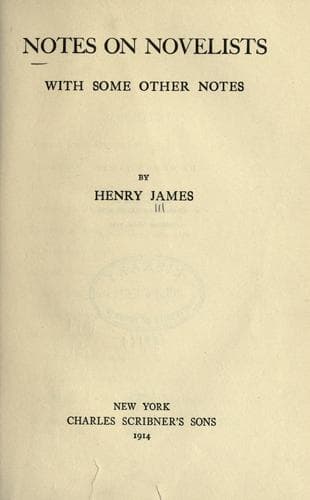
Notes on Novelists, with Some Other NotesJames, Henry
History
Notes on Novelists, with Some Other Notes
James, Henry
Fiction -- History and criticism; Novelists
It is never more so than when we
catch him, as we repeatedly do, in the act of positively caring for his
expression as expression, positively providing for his phrase as a
fondly foreseeing parent for a child, positively loving it in the light
of what it may do for him—meeting revelations, that is, in what it may
do, and appearing to recognise that the value of the offered thing, its
whole relation to us, is created by the breath of language, that on such
terms exclusively, for appropriation and enjoyment, we know it, and that
any claimed independence of “form” on its part is the most abject of
fallacies. Do these things mean that, moved by life, this interesting
young novelist is even now uncontrollably on the way to style? We might
cite had we space several symptoms, the very vividest, of that
possibility; though such an appearance in the field of our general
survey has against it presumptions enough to bring us surely back to our
original contention—the scant degree in which that field has ever had
to reckon with criticism.
DUMAS THE YOUNGER
1895
One of the things that most bring home his time of life to a man of
fifty is the increase of the rate at which he loses his friends. Some
one dies every week, some one dies every day, and if the rate be high
among his coevals it is higher still in the generation that, on awaking
to spectatorship, he found in possession of the stage. He begins to feel
his own world, the world of his most vivid impressions, gradually become
historical. He is present, and closely present, at the process by which
legend grows up. He sees the friends in question pictured as only death
can picture them—a master superior to the Rembrandts and Titians. They
have been of many sorts and many degrees, they have been private and
public, but they have had in common that they were the furniture of this
first fresh world, the world in which associations are formed. That one
by one they go is what makes the main difference in it. The landscape of
life, in foreground and distance, becomes, as the painters say, another
composition, another subject; and quite as much as the objects directly
under our eyes we miss the features that have educated for us our sense
of proportion.
Public-domain text, read in full here on John Shaqi.
Reviews
Reviews
No reviews yet
Be the first to share your thoughts on this work.
Elsewhere in the archive
Join the Discussion
Join the discussion
Sign in to leave a comment or review.
Sign InorCreate an account