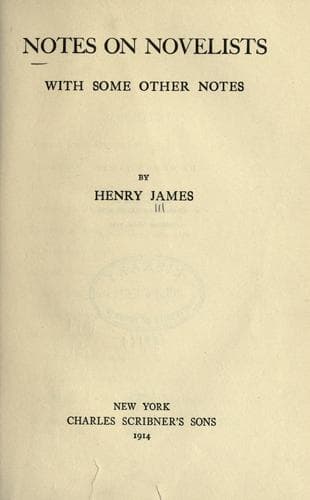
Notes on Novelists, with Some Other NotesJames, Henry
History
Notes on Novelists, with Some Other Notes
James, Henry
Fiction -- History and criticism; Novelists
Among such features for the author of these lines the younger Dumas, who
has just passed away, was in the public order long one of the most
conspicuous. Suffused as he is already with the quick historic haze,
fixed, for whatever term, in his ultimate value, he appeals to me, I
must begin by declaring, as a party to one of these associations that
have the savour of the prime. I knew him only in his work, but he is the
object of an old-time sentiment for the beginning of which I have to go
back absurdly far. He arrived early—he was so loudly introduced by his
name. I am tempted to say that I knew him when he was young, but what I
suppose I mean is that I knew him when I myself was. I knew him indeed
when we both were, for I recall that in Paris, in distant days and
undeveloped conditions, I was aware with perhaps undue and uncanny
precocity of his first successes. There emerges in my memory from the
night of time the image of a small boy walking in the Palais Royal with
innocent American girls who were his cousins and wistfully hearing them
relate how many times (they lived in Paris) they had seen Madame Doche
in “La Dame aux Camélias” and what floods of tears she had made them
weep. It was the first time I had heard of pockethandkerchiefs as a
provision for the play. I had no remotest idea of the social position of
the lady of the expensive flowers, and the artless objects of my envy
had, in spite of their repeated privilege, even less of one; but her
title had a strange beauty and her story a strange meaning—things that
ever after were to accompany the name of the author with a faint yet
rich echo. The younger Dumas, after all, was then not only relatively
but absolutely young; the American infants, privileged and unprivileged,
were only somewhat younger; the former going with their _bonne_, who
must have enjoyed the adventure, to the “upper boxes” of the old
Vaudeville of the Place de la Bourse, where later on I remember thinking
Madame Fargueil divine. He was quite as fortunate moreover in his own
designation as in that of his heroine; for it emphasised that bloom of
youth (I don’t say bloom of innocence—a very different matter) which
was the signal-note of the work destined, in the world at large, to
bring him nine-tenths of his celebrity.
Public-domain text, read in full here on John Shaqi.
Reviews
Reviews
No reviews yet
Be the first to share your thoughts on this work.
Elsewhere in the archive
Join the Discussion
Join the discussion
Sign in to leave a comment or review.
Sign InorCreate an account