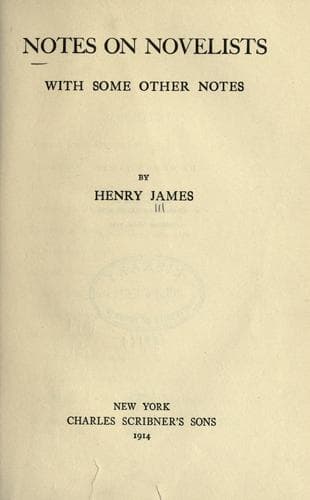
Notes on Novelists, with Some Other NotesJames, Henry
History
Notes on Novelists, with Some Other Notes
James, Henry
Fiction -- History and criticism; Novelists
Written at twenty-five “La Dame aux Camélias” remains in its combination
of freshness and form, of the feeling of the springtime of life and the
sense of the conditions of the theatre, a singular, an astonishing
production. The author has had no time to part with his illusions, but
has had full opportunity to master the most difficult of the arts.
Consecrated as he was to this mastery he never afterwards showed greater
adroitness than he had then done in keeping his knowledge and his
_naïveté_ from spoiling each other. The play has been blown about the
world at a fearful rate, but it has never lost its happy juvenility, a
charm that nothing can vulgarise. It is all champagne and tears—fresh
perversity, fresh credulity, fresh passion, fresh pain. We have each
seen it both well done and ill done, and perhaps more particularly the
latter—in strange places, in barbarous tongues, with Marguerite Gautier
fat and Armand Duval old. I remember ages ago in Boston a version in
which this young lady and this young gentleman were represented as
“engaged”: that indeed for all I know may still be the form in which the
piece most enjoys favour with the Anglo-Saxon public. Nothing makes any
difference—it carries with it an April air: some tender young man and
some coughing young woman have only to speak the lines to give it a
great place among the love-stories of the world. I recollect coming out
of the Gymnase one night when Madame Pierson had been the
Marguerite—this was very long since—and giving myself up on the
boulevard to a fine critical sense of what in such a composition was
flimsy and what was false. Somehow, none the less, my fine critical
sense never prevented my embracing the next opportunity to expose it to
the same irritation; for I have been, I am happy to think to-day, a
playgoer who, whatever else he may have had on his conscience, has never
had the neglect of any chance to see this dramatist acted. Least of all,
within a much shorter period, has it undermined one’s kindness to have
had occasion to admire in connection with the piece such an artist for
instance as Eleonora Duse. We have seen Madame Duse this year or two in
her tattered translation, with few advantages, with meagre accessories
and with one side of the character of the heroine scarcely touched at
all—so little indeed that the Italian version joins hands with the
American and the relation of Marguerite and Armand seems to present
itself as a question of the consecrated even if not approved “union.”
For this interesting actress, however, the most beautiful thing is
always the great thing, and her performance—if seen on a fortunate
evening—lives in the mind as a fine vindication of the play. I am not
sure indeed that it is the very performance Dumas intended; but he lived
long enough to have forgotten perhaps what that performance was. He
might on some sides, I think, have accepted Madame Duse’s as a reminder.
Public-domain text, read in full here on John Shaqi.
Reviews
Reviews
No reviews yet
Be the first to share your thoughts on this work.
Elsewhere in the archive
Join the Discussion
Join the discussion
Sign in to leave a comment or review.
Sign InorCreate an account