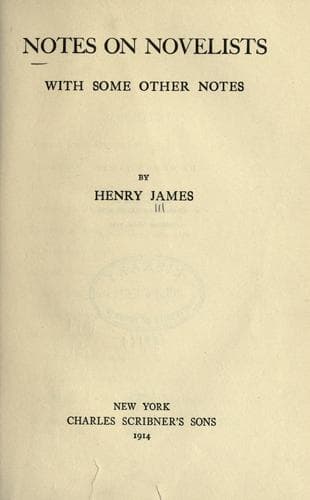
Notes on Novelists, with Some Other NotesJames, Henry
History
Notes on Novelists, with Some Other Notes
James, Henry
Fiction -- History and criticism; Novelists
If I have stopped to be myself so much reminded, it is because after and
outside of “La Dame aux Camélias” Dumas really never figured among us
all again—a circumstance full of illustration of one of the most
striking of our peculiarities, the capacity for granting a prodigious
ear to some one manifestation of an author’s talent and caring nothing
whatever for the others. It is solely the manifestation and never the
talent that interests us, and nothing is stranger than the fact that no
critic has ever explained on our behalf the system by which we hurl
ourselves on a writer to-day and stare at him to-morrow as if we had
never heard of him. It gives us the air of perpetually awaking from
mistakes, but it renders obscure all our canons of judgment. A great
force makes a great success, but a great force is furthermore no less a
great force on Friday than on Monday. Was the reader a sorry dupe on the
first day, or is the writer a wanton sacrifice on the second? That the
public is intelligent on both occasions is a claim it can scarcely make:
it can only choose between having its acuteness impugned or its manners
condemned. At any rate if we have in England and the United States only
the two alternatives of the roar of the market and the silence of the
tomb the situation is apt to be different in France, where the quality
that goes into a man’s work and gives it an identity is the source of
the attention excited. It happens that the interest in the play of the
genius is greater there than the “boom” of the particular hit, the
concern primarily for the author rather than the subject, instead of, as
among ourselves, primarily for the subject rather than the author. Is
this because the French have been acute enough to reflect that authors
comprehend subjects, but that subjects can unfortunately not be said to
comprehend authors? Literature would be a merry game if the business
were arranged in the latter fashion. However such a question may be
answered, Dumas was in his own country, to the end, the force that, save
in connection with his first play, he failed to become elsewhere; and if
he was there much the most original worker in his field one of the
incidental signs of his originality was that, despite our inveterate
practice, in theatrical matters, of helping ourselves from our
neighbour’s plate, he was inveterately not a convenience to us. We
picked our morsels from the plates of smaller people—we never found on
that of the author of “Le Fils Naturel” any we could swallow. He was not
to our poor purpose, and I cannot help thinking that this helps a little
to give his artistic measure. It would be a bad note for him now if we
had found him amenable to that graceless game of which we show signs
to-day of having grown ashamed, but which flourished for years in two
imperturbable communities as the art of theatrical adaptation. A Dumas
adaptable is a Dumas inconceivable; and in point of fact he was touched
Public-domain text, read in full here on John Shaqi.
Reviews
Reviews
No reviews yet
Be the first to share your thoughts on this work.
Elsewhere in the archive
Join the Discussion
Join the discussion
Sign in to leave a comment or review.
Sign InorCreate an account