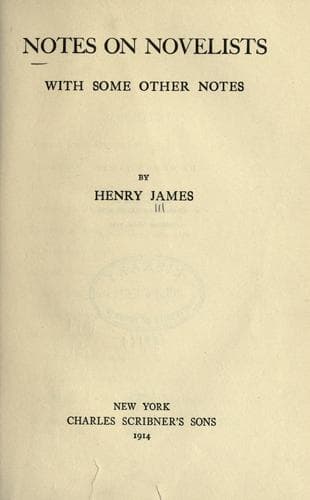
Notes on Novelists, with Some Other NotesJames, Henry
History
Notes on Novelists, with Some Other Notes
James, Henry
Fiction -- History and criticism; Novelists
What mattered to him the fact of a reach of reference that stopped
at the _banlieue_, when experience had sat at his cradle in the shape
not at all of a fairy godmother but of an immediate progenitor who was
at once fabulous and familiar? He had been encompassed by all history in
being held in such arms—it was an entrance into possession of more
matters than he could even guess what to do with. The profit was all the
greater as the son had the luxury of differing actively from the father,
as well as that of actively admiring and, in a splendid sense, on all
the becoming sides, those of stature, strength and health, vividly
reproducing him. He had in relation to his special gift, his mastery of
the dramatic form, a faculty of imagination as contracted as that of the
author of “Monte Cristo” was boundless, but his moral sense on the other
hand, as distinguished from that of his parent, was of the liveliest,
was indeed of the most special and curious kind. The moral sense of the
parent was to be found only in his good humour and his good health—the
moral sense of a musketeer in love. This lack of adventurous vision, of
the long flight and the joy of motion, was in the younger genius quite
one of the conditions of his strength and luck, of his fine assurance,
his sharp edge, his high emphasis, his state untroubled above all by
things not within his too irregularly conditioned ken. The things close
about him were the things he saw—there were alternatives, differences,
opposites, of which he lacked so much as the suspicion. Nothing
contributes more to the prompt fortune of an artist than some such
positive and exclusive temper, the courage of his convictions, as we
usually call it, the power to neglect something thoroughly, to abound
aggressively in his own sense and express without reserve his own
saturation. The saturation of the author of “Le Demi-Monde” was never
far to seek. He was as native to Paris as a nectarine to a south wall.
He would have fared ill if he had not had a great gift and Paris had not
been a great city.
Public-domain text, read in full here on John Shaqi.
Reviews
Reviews
No reviews yet
Be the first to share your thoughts on this work.
Elsewhere in the archive
Join the Discussion
Join the discussion
Sign in to leave a comment or review.
Sign InorCreate an account