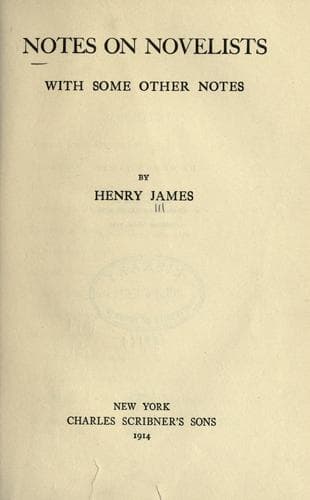
Notes on Novelists, with Some Other NotesJames, Henry
History
Notes on Novelists, with Some Other Notes
James, Henry
Fiction -- History and criticism; Novelists
It was another element of the happy mixture that he came into the world
at the moment in all our time that was for a man of letters the most
amusing and beguiling—the moment exactly when he could see the end of
one era and the beginning of another and join hands luxuriously with
each. This was an advantage to which it would have taken a genius more
elastic to do full justice, but which must have made him feel himself
both greatly related and inspiringly free. He sprang straight from the
lap of full-grown romanticism; he was a boy, a privileged and initiated
youth, when his father, when Victor Hugo, when Lamartine and Musset and
Scribe and Michelet and Balzac and George Sand were at the high tide of
production. He saw them all, knew them all, lived with them and made of
them his profit, tasting just enough of the old concoction to understand
the proportions in which the new should be mixed. He had above all in
his father, for the purpose that was in him, a magnificent
springboard—a background to throw into relief, as a ruddy sunset seems
to make a young tree doubly bristle, a profile of another type. If it
was not indispensable it was at any rate quite poetic justice that the
successor to the name should be, in his conditions, the great casuist of
the theatre. He had seen the end of an age of imagination, he had seen
all that could be done and shown in the way of mere illustration of the
passions. That the passions are always with us is a fact he had not the
smallest pretension to shut his eyes to—they were to constitute the
almost exclusive subject of his study. But he was to study them not for
the pleasure, the picture, the poetry they offer; he was to study them
in the interest of something quite outside of them, about which the
author of “Antony” and “Kean,” about which Victor Hugo and Musset,
Scribe and Balzac and even George Sand had had almost nothing to say. He
was to study them from the point of view of the idea of the right and
the wrong, of duty and conduct, and he was to this end to spend his
artistic life with them and give a new turn to the theatre. He was in
short to become, on the basis of a determined observation of the manners
of his time and country, a professional moralist.
Public-domain text, read in full here on John Shaqi.
Reviews
Reviews
No reviews yet
Be the first to share your thoughts on this work.
Elsewhere in the archive
Join the Discussion
Join the discussion
Sign in to leave a comment or review.
Sign InorCreate an account