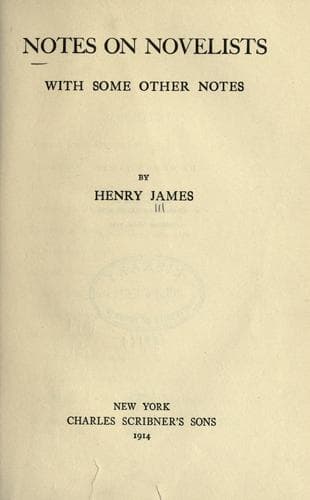
Notes on Novelists, with Some Other NotesJames, Henry
History
Notes on Novelists, with Some Other Notes
James, Henry
Fiction -- History and criticism; Novelists
There can scarcely be a better illustration of differences of national
habit and attitude than the fact that while among his own people this is
the character, as an operative force, borne by the author of “Le
Demi-Monde” and “Les Idées de Madame Aubray,” so among a couple of
others, in the proportion in which his reputation there has emerged from
the vague, his most definite identity is that of a mere painter of
indecent people and indecent doings. There are, as I have hinted,
several reasons for the circumstance already noted, the failure of the
attempt to domesticate him on the English-speaking stage; but one states
the case fairly, I think, in saying that what accounts for half of it is
our passion, in the presence of a work of art, for confounding the
object, as the philosophers have it, with the subject, for losing sight
of the idea in the vehicle, of the intention in the fable. Dumas is a
dramatist as to whom nine playgoers out of ten would precipitately
exclaim: “Ah, but you know, isn’t he dreadfully immoral?” Such are the
lions in the path of reputation, such the fate, in an alien air, of a
master whose main reproach in his native clime is the importunity and
the rigour of his lesson. The real difference, I take it, is that
whereas we like to be good the French like to be better. We like to be
moral, they like to moralise. This helps us to understand the number of
our innocent writers—writers innocent even of reflection, a practice of
course essentially indelicate, inasmuch as it speedily brings us face to
face with scandal and even with evil. It accounts doubtless also for the
number of writers on the further side of the Channel who have made the
journey once for all and to whom, in the dangerous quarter they have
reached, it appears of the very nature of scandal and evil to be
inquired about. The whole undertaking of such a writer as Dumas is,
according to his light, to carry a particular, an esthetic form of
investigation as far as it will stretch—to study, and study thoroughly,
the bad cases. These bad cases were precisely what our managers and
adapters, our spectators and critics would have nothing to do with. It
defines indeed the separation that they should have been, in the light
in which he presented them, precisely what made them for his own public
exceptionally edifying. One of his great contentions is, for instance,
that seduced girls should under all circumstances be married—by
somebody or other, failing the seducer. This is a contention that, as we
feel, barely concerns us, shut up as we are in the antecedent conviction
that they should under no circumstances be seduced. He meets all the
cases that, as we see him, we feel to have been spread out before him;
meets them successively, systematically, at once with a great
earnestness and a great wit. He is exuberantly sincere: his good faith
sometimes obscures his humour, but nothing obscures his good faith. So
Public-domain text, read in full here on John Shaqi.
Reviews
Reviews
No reviews yet
Be the first to share your thoughts on this work.
Elsewhere in the archive
Join the Discussion
Join the discussion
Sign in to leave a comment or review.
Sign InorCreate an account