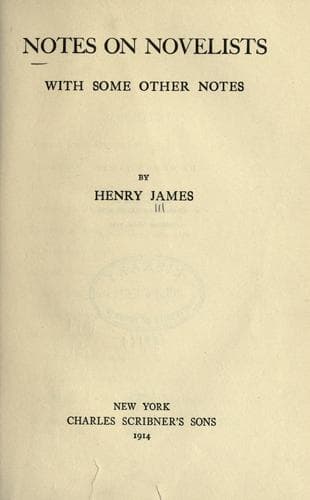
Notes on Novelists, with Some Other NotesJames, Henry
History
Notes on Novelists, with Some Other Notes
James, Henry
Fiction -- History and criticism; Novelists
he gives us in their order the unworthy brides who must be denounced,
the prenuptial children who must be adopted, the natural sons who must
be avenged, the wavering ladies who must be saved, the credulous fiancés
who must be enlightened, the profligate wives who must be shot, the
merely blemished ones who must be forgiven, the too vindictive ones who
must be humoured, the venal young men who must be exposed, the
unfaithful husbands who must be frightened, the frivolous fathers who
must be pulled up and the earnest sons who must pull them. To enjoy his
manner of dealing with such material we must grant him in every
connection his full premise: that of the importunity of the phenomenon,
the ubiquity of the general plight, the plight in which people are left
by an insufficient control of their passions. We must grant him in fact
for his didactic and dramatic purpose a great many things. These things,
taken together and added to some others, constitute the luxurious terms
on which I have spoken of him as appearing to the alien admirer to have
practised his complicated art.
When we speak of the passions in general we really mean, for the most
part, the first of the number, the most imperious in its action and the
most interesting in its consequences, the passion that unites and
divides the sexes. It is the passion, at any rate, to which Dumas as
dramatist and pamphleteer mainly devoted himself: his plays, his
prefaces, his manifestos, his few tales roll exclusively on the special
relation of the man to the woman and the woman to the man, and on the
dangers of various sorts, even that of ridicule, with which this
relation surrounds each party. This element of danger is what I have
called the general plight, for when our author considers the sexes as
united and divided it is with the predominance of the division that he
is principally struck. It is not an unfair account of him to say that
life presented itself to him almost wholly as a fierce battle between
the woman and the man. He sides now with one and now with the other; the
former combatant, in her own country, however, was far from pronouncing
him sympathetic. His subject at all events is what we of English race
call the sexes and what they in France call the sex. To talk of love is
to talk, as we have it, of men and women; to talk of love is, as the
French have it, to _parler femmes_. From every play of our author’s we
receive the impression that to _parler femmes_ is its essential and
innermost purpose. It is not assuredly singular that a novelist, a
dramatist _should_ talk of love, or even should talk of nothing else:
what, in addition to his adroitness and his penetration, makes the
position special for Dumas is that he talks of it—and in the form of
address most associated with pure diversion—altogether from the anxious
point of view of the legislator and the citizen.
Public-domain text, read in full here on John Shaqi.
Reviews
Reviews
No reviews yet
Be the first to share your thoughts on this work.
Elsewhere in the archive
Join the Discussion
Join the discussion
Sign in to leave a comment or review.
Sign InorCreate an account