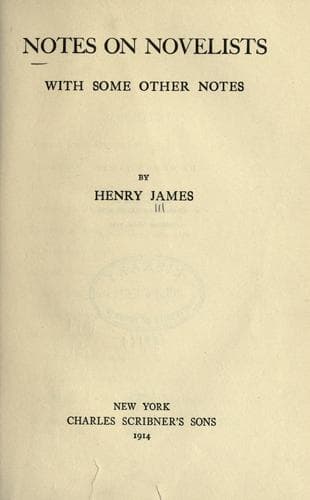
Notes on Novelists, with Some Other NotesJames, Henry
History
Notes on Novelists, with Some Other Notes
James, Henry
Fiction -- History and criticism; Novelists
“Diane de Lys,” which immediately followed “La Dame aux Camélias,” is,
so far as I can recall it, a picture pure and simple, a pretty story, as
we say, sufficiently romantic and rather long-winded; but with “Le
Demi-Monde” began his rich argumentative series, concluding only the
other day with “Denise” and “Francillon,” the series in which every
theme is a proposition to be established and every proposition a form of
duty to be faced. The only variation that I can recollect in the list is
the disinterested portraiture of “Le Père Prodigue,” with its remarkable
presentation, in the figure of Albertine de la Borde, of vice
domesticated and thrifty, keeping early hours and books in double-entry,
and its remarkable illustration, I may further add, of all that was the
reverse of infallible in the author’s power to distinguish between
amiable infirmities and ugly ones. The idea on which “Le Père Prodigue”
rests belongs more distinctively to the world of comedy than almost any
other situation exhibited in the series; but what are we to say of the
selection, for comic effect, of a fable of which the principal feature
is a son’s not unfounded suspicion of the attitude of his own father to
his own wife? The father is the image of a nature profusely frivolous,
but we scent something more frivolous still in the way his frivolity is
disposed of. At the time the play was produced the spectator thought
himself warranted in recognising in this picture the personal character
(certainly not the personal genius) of the elder Dumas. If the spectator
_was_ so warranted, that only helps, I think, to make “Le Père Prodigue”
a stumbling-block for the critic—make it, I mean, an exhibition of the
author off his guard and a fact to be taken into account in an estimate
of his moral reach; a moral reach, for the rest, at all events, never
impugned by any obliquity in facing that conception of the duty imposed
which it is the main source of the writer’s interest in the figured
circumstances that they may be held to impose it, and which he was apt
to set forth more dogmatically, or at least more excitedly, in an
occasional and polemical pamphlet. These pamphlets, I may
parenthetically say, strike me as definitely compromising to his
character as artist. What shines in them most is the appetite for a
discussion, or rather the appetite for a conclusion, and the passion for
a simplified and vindictive justice. But I have never found it easy to
forgive a writer who, in possession of a form capable of all sorts of
splendid application, puts on this resource the slight of using
substitutes for it at will, as if it is good but for parts of the cause.
If it is good for anything it is good for the whole demonstration, and
if it is not good for the whole demonstration it is good for
nothing—nothing that _he_ is concerned with. If the picture of life
doesn’t cover the ground what in the world _can_ cover it? The fault can
only be the painter’s.
Public-domain text, read in full here on John Shaqi.
Reviews
Reviews
No reviews yet
Be the first to share your thoughts on this work.
Elsewhere in the archive
Join the Discussion
Join the discussion
Sign in to leave a comment or review.
Sign InorCreate an account