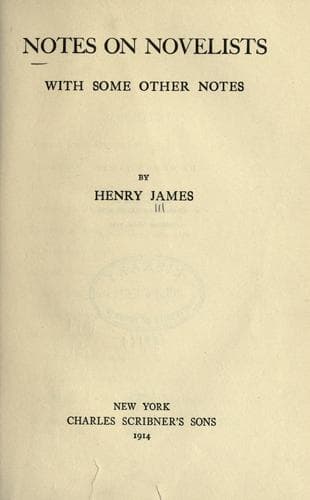
Notes on Novelists, with Some Other NotesJames, Henry
History
Notes on Novelists, with Some Other Notes
James, Henry
Fiction -- History and criticism; Novelists
Woe, in the esthetic line, to any example that
requires the escort of precept. It is like a guest arriving to dine
accompanied by constables. Our author’s prefaces and treatises show a
mistrust of disinterested art. He would have declared probably that his
art was not disinterested; to which our reply would be that it had then
no right to put us off the scent and prepare deceptions for us by coming
within an ace of being as good as if it were.
The merits of the play—that is of the picture, in these hands—are
sometimes singularly independent of the lesson conveyed. The merits of
the lesson conveyed are in other cases much more incontestable than
those of the picture, than the production of the air of life or the
happiest observance of the conditions of the drama. The conclusion, the
prescription, of “Denise” strikes me (to give an instance) as singularly
fine, but the subject belongs none the less to the hapless order of
those that fail to profit by the dramatic form though they have
sacrificed the highest advantages of the literary. A play—even the
best—pays so tremendously by what it essentially can not do for the
comparatively little it practically can, that a mistake in the
arithmetic of this positive side speedily produces a wide deviation. In
other words the spectator, and still more the reader, sees such a theme
as that of “Denise,” which may be described as the evolution of a view,
presented most in accordance with its nature when the attempt is not
made to present it in accordance with the nature of the theatre. It is
the nature of the theatre to give its victims, in exchange for
melancholy concessions, a vision of the immediate not to be enjoyed in
any other way; and consequently when the material offered it to deal
with is not the immediate, but the contingent, the derived, the
hypothetic, our melancholy concessions have been made in vain and the
inadequacy of the form comes out. In “Francillon,” partly perhaps
because the thing has nothing to do with anybody’s duty—least of all
with the heroine’s, which would be surely to keep off the streets—the
form happens to be remarkably adequate. The question is of the liberty
of the protagonist, the right of a wronged and indignant wife to work
out her husband’s chastisement in the same material as his sin, work it
out moreover on the spot, as a blow is repaid by a blow, exacting an eye
for an eye and a tooth for a tooth. The play has all the kinds of life
that the theatre can achieve, because in the first place Dumas, though
acting as the wife’s advocate, has had the intelligence to give us a
solution which is only a scenic sequence and not a real, still less a
“philosophic,” one; and because in the second it deals with emotions and
impulses, which can be shown by the short measure, and not with
reflections and aspirations, which can be shown but by the long.
Public-domain text, read in full here on John Shaqi.
Reviews
Reviews
No reviews yet
Be the first to share your thoughts on this work.
Elsewhere in the archive
Join the Discussion
Join the discussion
Sign in to leave a comment or review.
Sign InorCreate an account