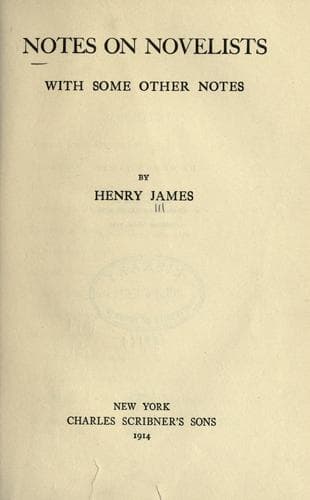
Notes on Novelists, with Some Other NotesJames, Henry
History
Notes on Novelists, with Some Other Notes
James, Henry
Fiction -- History and criticism; Novelists
I am not pretending to take things in turn, but a critic with a generous
memory of the spell of Dumas should not, however pressed, neglect to
strain a point for “Le Demi-Monde.” I doubt my competence, however, to
consider that admirable work scientifically—I find myself too condemned
to consider it sentimentally. A critic is lost, as a critic, from the
moment his feeling about the worse parts of the matter he investigates
fails to differ materially from his feeling about the better. That is an
attitude even less enlightened than being unconscious of the blemishes;
all the same it must serve me for the present case. I am perfectly aware
that Olivier de Jalin is a man of no true delicacy; in spite of which I
take when I see them represented the liveliest interest in his
proceedings. I am perfectly aware that Madame d’Ange, with her _calme
infernal_, as George Sand calls it, is tainted and tortuous; in spite of
which my imagination quite warms to Madame d’Ange. Perhaps I should
indeed rather say that this interest and this sympathy have for their
object the great total of the play. It is the member of the series in
which Dumas first took up the scales in one hand and the sword in the
other, and it is a wonderful piece of work, wonderful in kind of
maturity, for a man of thirty. It has all the easy amplitude we call
authority. I won’t pretend to say what I think, here, of the author’s
justice, and if I happen to think ill of it I won’t pretend to care. I
see the thing through too many old memories, old echoes, old charms. In
the light of the admirable acting of ancient days, of the faded image of
the exquisite Desclée, of a dim recollection even of the prehistoric
Rose Chéri and of Mademoiselle Delaporte, it represents too many of the
reasons why I saw him always ideally triumphant. To practise an art
which for its full, its rich effect depended on interpretation, and to
be able to do one’s work with an eye on interpretation of that
quality—this had in common with supreme bliss the element at any rate
of being attainable only by the elect. It partook of a peace the world
cannot give. To be a moralist with the aid of Croizette, a philosopher
with the aid of Delaunay, an Academician, even, with the aid of
Bartet—such things suggested an almost equivocal union of virtue and
success. One had never seen virtue so agreeable to one’s self, nor
success so useful to others. One had never seen a play that was a model
so alive in spite of it. Models in the theatre were apt to be dead and
vivacities vulgar. One had never above all seen on the stage a picture
so conformable to deep pictorial art, a drama so liberally, gradually,
scientifically flushed with its action. Beautiful in “Le Demi-Monde” is
the way the subject quietly, steadily, strongly expands from within.
Public-domain text, read in full here on John Shaqi.
Reviews
Reviews
No reviews yet
Be the first to share your thoughts on this work.
Elsewhere in the archive
Join the Discussion
Join the discussion
Sign in to leave a comment or review.
Sign InorCreate an account