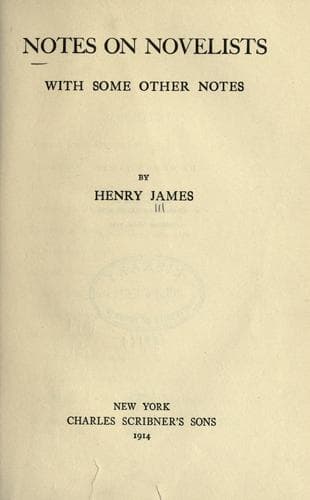
Notes on Novelists, with Some Other NotesJames, Henry
History
Notes on Novelists, with Some Other Notes
James, Henry
Fiction -- History and criticism; Novelists
It was always the coercive force that his tone gave one the strongest
sense of life, and it remains the interesting thing that this element in
Dumas abounds in spite of not being fed from the source that we usually
assume to be the richest. It was not fed from the imagination, for his
imagination, by no means of the great plastic sort, has left us a
comparatively small heritage of typical figures. His characters are all
pointed by observation, they are clear notes in the concert, but not one
of them has known the little invisible push that, even when shyly and
awkwardly administered, makes the puppet, in spite of the string, walk
off by himself and quite “cut,” if the mood take him, that distant
relation his creator. They are always formal with this personage and
thoroughly conscious and proud of him; there is a charm of mystery and
poetry and oddity, a glory of unexpectedness, that they consistently
lack. Their life, and that, in each case, of the whole story (quite the
most wonderful part of this) is simply the author’s own life, his high
vitality, his very presence and temperament and voice. They do more for
him even than they do for the subject, and he himself is at last
accordingly the most vivid thing in every situation. He keeps it at
arm’s length because he has the instinct of the dramatist and the
conscience of the artist, but we feel all the while that his face is
bigger than his mask. Nothing about his work is more extraordinary than
this manner in which his personality pervades without spoiling it the
most detached and most impersonal of literary forms. The reasons for
such an impunity are first that his precautions, the result of a great
intelligence, were so effective, and second that his personality, the
result of a great affiliation, was so robust. It may be said that the
precautions were not effective if the man himself was what one most
enjoyed in the play. The only answer to that can be that I speak merely
for myself and for the fresher sensibility of the happy time. Other
admirers found certainly other things; what I found most was a tall
figure in muscular motion and the sense of a character that had made
admirably free with life. If it was mainly as an unabashed observer that
he had made free, and if the life supplied was much of it uncommonly
queer, that never diminished the action of his hard masculinity and his
fine intellectual brutality. There was an easy competence in it all, and
a masterful experience, and a kind of vicarious courage. In particular
there was a real genius for putting all persons—especially all bad
ones—very much in their place. Then it was all, for another bribe, so
copious and so close, so sustained and so quiet, with such fascinating
unities and complex simplicities and natural solutions. It was the
breath of the world and the development of an art.
Public-domain text, read in full here on John Shaqi.
Reviews
Reviews
No reviews yet
Be the first to share your thoughts on this work.
Elsewhere in the archive
Join the Discussion
Join the discussion
Sign in to leave a comment or review.
Sign InorCreate an account