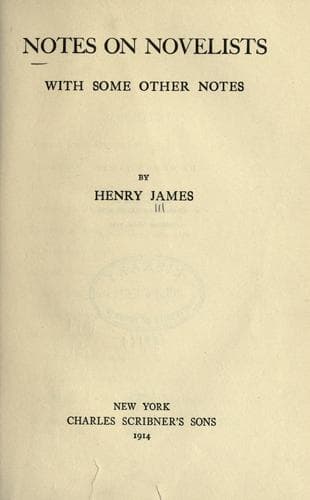
Notes on Novelists, with Some Other NotesJames, Henry
History
Notes on Novelists, with Some Other Notes
James, Henry
Fiction -- History and criticism; Novelists
opens, Violante presents herself. He stabs her to death on the spot with
repeated blows—like her companions she is off her guard; and he throws
himself on each of these with equal murderous effect. Pietro, crying for
mercy, falls second beneath him; after which he attacks his wife, whom
he literally hacks to death. She survives, by a miracle, long enough, in
spite of all her wounds, to testify; which testimony, as may be
imagined, is not the least precious part of the case. Justice is on the
whole, though deprecated and delayed, what we call satisfactory; the
last word is for the Pope in person, Innocent XII. Pignatelli, at whose
deliberation, lone and supreme, on Browning’s page, we splendidly
assist; and Count Guido and his accomplices, bloodless as to the act
though these appear to have been, meet their discriminated doom.
That is the bundle of facts, accompanied with the bundle of proceedings,
legal, ecclesiastical, diplomatic and other, _on_ the facts, that our
author, of a summer’s day, made prize of; but our general temptation, as
I say—out of which springs this question of the other values of
character and effect, the other completeness of picture and drama, that
the confused whole might have had for us—is a distinctly different
thing. The difference consists, you see, to begin with, in the very
breath of our poet’s genius, already, and so inordinately, at play on
them from the first of our knowing them. And it consists in the second
place of such an extracted sense of the whole, which becomes, after the
most extraordinary fashion, bigger by the extraction, immeasurably
bigger than even the most cumulative weight of the mere crude evidence,
that our choice of how to take it all is in a manner determined for us:
we can only take it as tremendously interesting, interesting not only in
itself but with the great added interest, the dignity and authority and
beauty, of Browning’s general perception of it. We can’t not accept
this, and little enough on the whole do we want not to: it sees us, with
its tremendous push, that of its poetic, esthetic, historic, psychologic
shoulder (one scarce knows how to name it), so far on our way. Yet all
the while we are in presence not at all of an achieved form, but of a
mere preparation for one, though on the hugest scale; so that, you see,
we are no more than decently attentive with our question: “Which of them
all, of the various methods of casting the wondrously mixed metal, is
he, as he goes, preparing?” Well, as he keeps giving and giving, in
immeasurable plenty, it is in our selection from it all and our picking
it over that we seek, and to whatever various and unequal effect find,
our account. He works over his vast material, and we then work _him_
over, though not availing ourselves, to this end, of a grain he himself
doesn’t somehow give us; and there we are.
Public-domain text, read in full here on John Shaqi.
Reviews
Reviews
No reviews yet
Be the first to share your thoughts on this work.
Elsewhere in the archive
Join the Discussion
Join the discussion
Sign in to leave a comment or review.
Sign InorCreate an account