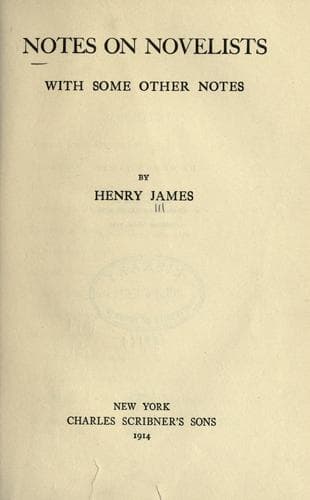
Notes on Novelists, with Some Other NotesJames, Henry
History
Notes on Novelists, with Some Other Notes
James, Henry
Fiction -- History and criticism; Novelists
I admit that my faith in my particular contention would be a degree
firmer and fonder if there didn’t glimmer through our poet’s splendid
hocus-pocus just the hint of one of those flaws that sometimes deform
the fair face of a subject otherwise generally appealing or
promising—of such a subject in especial as may have been submitted to
us, possibly even with the pretension to impose it, in too complete a
shape. The idea but half hinted—when it is a very good one—is apt to
contain the germ of happier fruit than the freight of the whole branch,
waved at us or dropped into our lap, very often proves. This happens
when we take over, as the phrase is, established data, take them over
from existing records and under some involved obligation to take them as
they stand. That drawback rests heavily for instance on the so-called
historic fiction—so beautiful a case it is of a muddlement of
terms—and is just one of the eminent reasons why the embarrassed Muse
of that form, pulled up again and again, and the more often the fine
intelligence invokes her, by the need of a superior harmony which shall
be after all but a superior truth, catches up her flurried skirts and
makes her saving dash for some gap in the hedge of romance. Now the flaw
on this so intensely expressive face, that of the general _donnée_ of
the fate of Pompilia, is that amid the variety of forces at play about
her the unity of the situation isn’t, by one of those large straight
ideal gestures on the part of the Muse, handed to us at a stroke. The
question of the whereabouts of the unity of a group of data subject to
be wrought together into a thing of art, the question in other words of
the point at which the various implications of interest, no matter how
many, _most_ converge and interfuse, becomes always, by my sense of the
affair, quite the first to be answered; for according to the answer
shapes and fills itself the very vessel of that beauty—the beauty,
exactly, _of_ interest, of maximum interest, which is the ultimate
extract of any collocation of facts, any picture of life, and the finest
aspect of any artistic work. Call a novel a picture of life as much as
we will; call it, according to one of our recent fashions, a slice, or
even a chunk, even a “bloody” chunk, of life, a rough excision from that
substance as superficially cut and as summarily served as possible, it
still fails to escape this exposure to appreciation, or in other words
to criticism, that it has had to be selected, selected under some sense
for something; and the unity of the exhibition should meet us, does meet
us if the work be done, at the point at which that sense is most patent.
If the slice or the chunk, or whatever we call it, if _it_ isn’t “done,”
as we say—and as it so often declines to be—the work itself of course
isn’t likely to be; and there we may dismiss it.
Public-domain text, read in full here on John Shaqi.
Reviews
Reviews
No reviews yet
Be the first to share your thoughts on this work.
Elsewhere in the archive
Join the Discussion
Join the discussion
Sign in to leave a comment or review.
Sign InorCreate an account