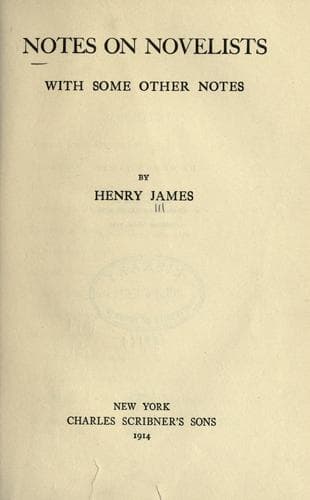
Notes on Novelists, with Some Other NotesJames, Henry
History
Notes on Novelists, with Some Other Notes
James, Henry
Fiction -- History and criticism; Novelists
The first thing we do is to cast about for some centre in our field;
seeing that, for such a purpose as ours, the subject might very nearly
go a-begging with none more definite than the author has provided for
it. I find that centre in the embracing consciousness of Caponsacchi,
which, coming to the rescue of our question of treatment, of our search
for a point of control, practically saves everything, and shows itself
moreover the only thing that _can_ save. The more we ask of any other
part of our picture that it shall exercise a comprehensive function, the
more we see that particular part inadequate; as inadequate even in the
extraordinarily magnified range of spirit and reach of intelligence of
the atrocious Franceschini as in the sublime passivity and plasticity of
the childish Pompilia, educated to the last point though she be indeed
by suffering, but otherwise so untaught that she can neither read nor
write. The magnified state is in this work still more than elsewhere the
note of the intelligence, of any and every faculty of thought, imputed
by our poet to his creatures; and it takes a great mind, one of the
greatest, we may at once say, to make these persons express and confess
themselves to such an effect of intellectual splendour. He resorts
primarily to _their_ sense, their sense of themselves and of everything
else they know, to exhibit them, and has for this purpose to keep them,
and to keep them persistently and inexhaustibly, under the fixed lens of
his prodigious vision. He this makes out in them boundless treasures of
truth—truth even when it happens to be, as in the case of Count Guido,
but a shining wealth of constitutional falsity. Of the extent to which
he may after this fashion unlimitedly draw upon them his exposure of
Count Guido, which goes on and on, though partly, I admit, by repeating
itself, is a wondrous example. It is not too much to say of
Pompilia—Pompilia pierced with twenty wounds, Pompilia on her
death-bed, Pompilia but seventeen years old and but a fortnight a
mother—that she _acquires_ an intellectual splendour just by the fact
of the vast covering charity of imagination with which her recording,
our commemorated, avenger, never so as in this case an avenger of the
wronged beautiful things in life, hangs over and breathes upon her. We
see her come out to him, and the extremely remarkable thing is that we
see it, on the whole, without doubting that it might just have been.
Nothing could thus be more interesting, however it may at moments and in
places puzzle us, than the impunity, on our poet’s part, of most of
these overstretchings of proportion, these violations of the immediate
appearance. Browning is deep down below the immediate with the first
step of his approach; he has vaulted over the gate, is already far
afield and never, so long as we watch him, has occasion to fall back. We
wonder, for, after all, the real is his quest, the very ideal of the
Public-domain text, read in full here on John Shaqi.
Reviews
Reviews
No reviews yet
Be the first to share your thoughts on this work.
Elsewhere in the archive
Join the Discussion
Join the discussion
Sign in to leave a comment or review.
Sign InorCreate an account