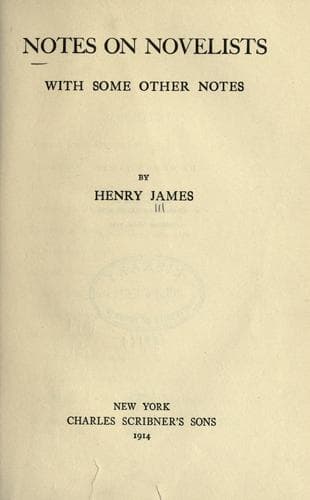
Notes on Novelists, with Some Other NotesJames, Henry
History
Notes on Novelists, with Some Other Notes
James, Henry
Fiction -- History and criticism; Novelists
real, the real most finely mixed with life, which _is_ in the last
analysis the ideal; and we know, with our dimmer vision, no such reality
as a Franceschini fighting for his life, fighting for the vindication of
his baseness, embodying his squalor, with an audacity of wit, an
intensity of colour, a variety of speculation and illustration, that
represent well-nigh the maximum play of the human mind. It is in like
sort scarce too much to say of the exquisite Pompilia that on her part
intelligence and expression are disengaged to a point at which the
angels may well begin to envy her; and all again without our once
wincing so far as our consistently liking to see and hear and believe is
concerned. Caponsacchi regales us, of course, with the rarest fruit of a
great character, a great culture and a great case; but Caponsacchi is
acceptedly and naturally, needfully and illustratively, splendid. He
_is_ the soul of man at its finest—having passed through the smoky
fires of life and emerging clear and high. Greatest of all the spirits
exhibited, however, is that of the more than octogenarian Pope, at whose
brooding, pondering, solitary vigil, by the end of a hard grey winter
day in the great bleak waiting Vatican—“in the plain closet where he
does such work”—we assist as intimately as at every other step of the
case, and on whose grand meditation we heavily hang. But the Pope
strikes us at first—though indeed perhaps only at first—as too high
above the whole connection functionally and historically for us to place
him within it dramatically. Our novel faces provisionally the question
of dispensing with him, as it dispenses with the amazing, bristling, all
too indulgently presented Roman advocates on either side of the case,
who combine to put together the most formidable monument we possess to
Browning’s active curiosity and the liveliest proof of his almost
unlimited power to give on his readers’ nerves without giving on his
own.
Public-domain text, read in full here on John Shaqi.
Reviews
Reviews
No reviews yet
Be the first to share your thoughts on this work.
Elsewhere in the archive
Join the Discussion
Join the discussion
Sign in to leave a comment or review.
Sign InorCreate an account