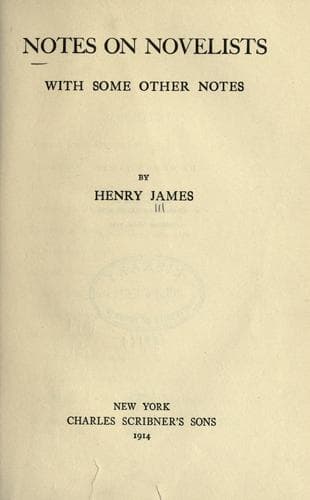
Notes on Novelists, with Some Other NotesJames, Henry
History
Notes on Novelists, with Some Other Notes
James, Henry
Fiction -- History and criticism; Novelists
What remains with us all this time, none the less, is the effect of
magnification, the exposure of each of these figures, in its degree, to
that iridescent wash of personality, of temper and faculty, that our
author ladles out to them, as the copious share of each, from his own
great reservoir of spiritual health, and which makes us, as I have
noted, seek the reason of a perpetual anomaly. Why, bristling so with
references to _him_ rather than with references to each other or to any
accompanying set of circumstances, do they still establish more truth
and beauty than they sacrifice, do they still, according to their
chance, help to make “The Ring and the Book” a great living thing, a
great objective mass? I brushed by the answer a moment ago, I think, in
speaking of the development in Pompilia of the resource of expression,
which brings us round, it seems to me, to the justification of
Browning’s method. To express his inner self—his outward was a
different affair!—and to express it utterly, even if no matter how, was
clearly, for his own measure and consciousness of that inner self, to
_be_ poetic; and the solution of all the deviations and disparities or,
speaking critically, monstrosities, in the mingled tissue of this work,
is the fact that whether or no by such convulsions of soul and sense
life got delivered for him, the garment of life (which for him was
poetry and poetry alone) got disposed in its due and adequate
multitudinous folds. We move with him but in images and references and
vast and far correspondences; we eat but of strange compounds and drink
but of rare distillations; and very soon, after a course of this, we
feel ourselves, however much or however little to our advantage we may
on occasion pronounce it, in the world of Expression at any cost. That,
essentially, _is_ the world of poetry—which in the cases known to our
experience where it seems to us to differ from Browning’s world does so
but through this latter’s having been, by the vigour and violence, the
bold familiarity, of his grasp and pull at it, moved several degrees
nearer us, so to speak, than any other of the same general sort with
which we are acquainted; so that, intellectually, we back away from it a
little, back down before it, again and again, as we try to get off from
a picture or a group or a view which is too much _upon_ us and thereby
out of focus. Browning is “upon” us, straighter upon us always, somehow,
than anyone else of his race; and we thus recoil, we push our chair
back, from the table he so tremendously spreads, just to see a little
better what is on it. This makes a relation with him that it is
difficult to express; as if he came up against us, each time, on the
same side of the street and not on the other side, across the way, where
we mostly see the poets elegantly walk, and where we greet them without
danger of concussion. It is on this same side, as I call it, on _our_
side, on the other hand, that I rather see our encounter with the
Public-domain text, read in full here on John Shaqi.
Reviews
Reviews
No reviews yet
Be the first to share your thoughts on this work.
Elsewhere in the archive
Join the Discussion
Join the discussion
Sign in to leave a comment or review.
Sign InorCreate an account