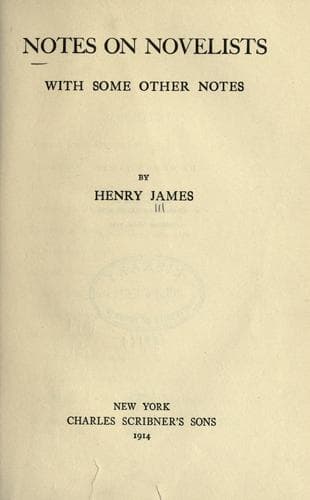
Notes on Novelists, with Some Other NotesJames, Henry
History
Notes on Novelists, with Some Other Notes
James, Henry
Fiction -- History and criticism; Novelists
novelists taking place; we being, as it were, more mixed with them, or
they at least, by their desire and necessity, more mixed with us, and
our brush of them, in their minor frenzy, a comparatively muffled
encounter.
We have in the whole thing, at any rate, the element of action which is
at the same time constant picture, and the element of picture which is
at the same time constant action; and with a fusion, as the mass moves,
that is none the less effective, none the less thick and complete, from
our not owing it in the least to an artful economy. Another force pushes
its way through the waste and rules the scene, making wrong things right
and right things a hundred times more so—that breath of Browning’s own
particular matchless Italy which takes us full in the face and remains
from the first the felt rich coloured air in which we live. The quantity
of that atmosphere that he had to give out is like nothing else in
English poetry, any more than in English prose, that I recall; and since
I am taking these liberties with him, let me take one too, a little,
with the fruit of another genius shining at us here in association—with
that great placed and timed prose fiction which we owe to George Eliot
and in which _her_ projection of the stage and scenery is so different a
matter. Curious enough this difference where so many things make for
identity—the quantity of talent, the quantity of knowledge, the high
equality (or almost) of culture and curiosity, not to say of “spiritual
life.” Each writer drags along a far-sweeping train, though indeed
Browning’s spreads so considerably furthest; but his stirs up, to my
vision, a perfect cloud of gold-dust, while hers, in “Romola,” by
contrast, leaves the air about as clear, about as white, and withal
about as cold, as before she had benevolently entered it. This straight
saturation of our author’s, this prime assimilation of the elements for
which the name of Italy stands, is a single splendid case, however; I
can think of no second one that is not below it—if we take it as
supremely expressed in those of his lyrics and shorter dramatic
monologues that it has most helped to inspire. The Rome and Tuscany of
the early ’fifties had become for him so at once a medium, a bath of the
senses and perceptions, into which he could sink, in which he could
unlimitedly soak, that wherever he might be touched afterwards he gave
out some effect of that immersion. This places him to my mind quite
apart, makes the rest of our poetic record of a similar experience
comparatively pale and abstract. Shelley and Swinburne—to name only his
compeers—are, I know, a part of the record; but the author of “Men and
Women,” of “Pippa Passes,” of certain of the Dramatic Lyrics and other
scattered felicities, not only expresses and reflects the matter; he
fairly, he heatedly, if I may use such a term, exudes and perspires it.
Shelley, let us say in the connection, is a light and Swinburne, let us
Public-domain text, read in full here on John Shaqi.
Reviews
Reviews
No reviews yet
Be the first to share your thoughts on this work.
Elsewhere in the archive
Join the Discussion
Join the discussion
Sign in to leave a comment or review.
Sign InorCreate an account