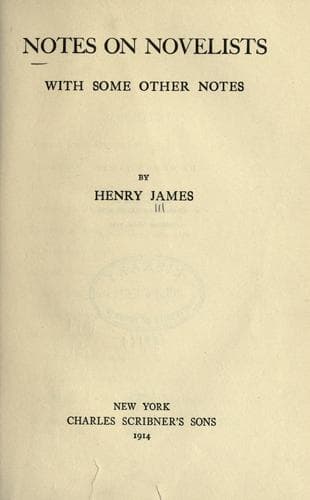
Notes on Novelists, with Some Other NotesJames, Henry
History
Notes on Novelists, with Some Other Notes
James, Henry
Fiction -- History and criticism; Novelists
theatre—the theatre of old Arezzo: share with me the tattered vision
and inhale the musty air!—I am well in range of Pompilia, the
tragically exquisite, in her box, with her husband not there for the
hour but posted elsewhere; I look at her in fact over Caponsacchi’s
shoulder and that of his brother-canon Conti, while this light
character, a vivid recruit to our company, manages to toss into her lap,
and as coming in guise of overture from his smitten friend, “a
papertwist of comfits.” There is a particular famous occasion at the
theatre in a work of more or less contemporary fiction—at a petty
provincial theatre which isn’t even, as you might think, the place where
Pendennis had his first glimpse of Miss Fotheringay. The evening at the
Rouen playhouse of Flaubert’s “Madame Bovary” has a relief not elsewhere
equalled—it is the most _done_ visit to the play in all
literature—but, though “doing” is now so woefully out of favour, my
idea would be to give it here a precious _pendant_; which connection,
silly Canon Conti, the old fripperies and levities, the whole queer
picture and show of manners, is handed over to us, expressly, as inapt
for poetic illustration.
What is equally apt for poetic or for the other, indeed, is the thing
for which we feel “The Ring and the Book” preponderantly done—it is at
least what comes out clearest, comes out as straightest and strongest
and finest, from Browning’s genius—the exhibition of the great
constringent relation between man and woman at once at its maximum and
as the relation most worth while in life for either party; an exhibition
forming quite the main substance of our author’s message. He has dealt,
in his immense variety and vivacity, with other relations, but on this
he has thrown his most living weight; it remains the thing of which his
own rich experience most convincingly spoke to him. He has testified to
it as charged to the brim with the burden of the senses, and has
testified to it as almost too clarified, too liberated and sublimated,
for traceable application or fair record; he has figured it as never too
much either of the flesh or of the spirit for him, so long as the
possibility of both of these is in each, but always and ever as the
thing absolutely most worth while. It is in the highest and rarest
degree clarified and disengaged for Caponsacchi and Pompilia; but what
their history most concludes to is how ineffably it was, whatever
happened, worth while. Worth while most then for them or for us is the
question? Well, let us say worth while assuredly for us, in this noble
exercise of our imagination. Which accordingly shows us what we, for all
our prose basis, would have found, to repeat my term once more, prepared
for us. There isn’t a detail of their panting flight to Rome over the
autumn Apennines—the long hours when they melt together only _not_ to
meet—that doesn’t positively plead for our perfect prose transcript.
And if it be said that the mere massacre at the final end is a lapse to
Public-domain text, read in full here on John Shaqi.
Reviews
Reviews
No reviews yet
Be the first to share your thoughts on this work.
Elsewhere in the archive
Join the Discussion
Join the discussion
Sign in to leave a comment or review.
Sign InorCreate an account