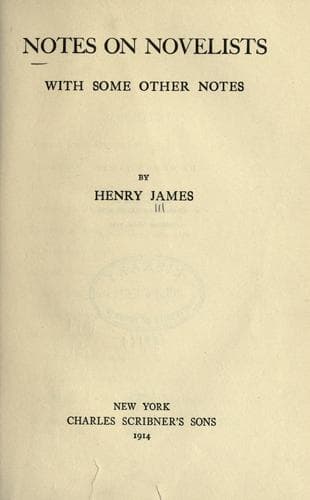
Notes on Novelists, with Some Other NotesJames, Henry
History
Notes on Novelists, with Some Other Notes
James, Henry
Fiction -- History and criticism; Novelists
I have no sooner, none the less, qualified it so ungraciously than I ask
myself what after all we should do without it. If we have opened the
floodgates we have at least opened them wide, and it is our very
quantity that perhaps in the last resort will save us. It cuts both
ways, as the phrase is—it covers all the ground; it helps the escape as
well as produces the assault. If retreat for instance at the present
juncture is, as I began by hinting, urgently imposed, it is thanks to
our having so much of everything that we find a bridge for our feet. We
hope to get off in time, but meanwhile even on the spot there are
blessed alternatives and reliefs. I have been trying a number very hard,
but I have expatiated so on the complaint that I have left little room
for the remedy. London reminds one of nothing so often as of the help
she gives one to forget her. One of the forms actually taken by this
happy habit is the ingenious little exhibition, at the Grafton
Galleries, of so-called Dramatic and Musical Art. The name is rather a
grand one and the show has many gaps; but it profits, as such places in
London so often profit, by the law that makes you mostly care less what
you get into than what you get out of. With its Hogarths and
Zoffanys—none too many, I admit—its other last-century portraits and
relics, its numerous ghosts of Garrick, its old play-bills and prints,
its echoes of dead plaudits and its very thin attendance, it happens to
be for the moment a quiet bower in the bear-garden. It is a “scratch”
company, but only—and I can scarce say why—in the portion in which the
portraits of the day prevail is the impression vulgar. Even there indeed
this suspicion receives a grand lift from Mr. Whistler’s exquisite image
of Henry Irving as the Philip of Tennyson’s “Queen Mary.” To pause
before such a work is in fact to be held to the spot by just the highest
operation of the charm one has sought there—the charm of a certain
degree of melancholy meditation. Meditation indeed forgets Garrick and
Hogarth and all the handsome heads of the Kembles in wonder
reintensified at the attitude of a stupid generation toward an art and a
taste so rare. Wonder is perhaps after all not the word to use, for how
_should_ a stupid generation, liking so much that it does like and with
a faculty trained to coarser motions, recognise in Mr. Whistler’s work
one of the finest of all distillations of the artistic intelligence? To
turn from his picture to the rest of the show—which, of course, I
admit, is not a collection of masterpieces—is to drop from the world of
distinction, of perception, of beauty and mystery and perpetuity,
into—well, a very ordinary place. And yet the effect of Whistler at his
best is exactly to give to the place he hangs in—or perhaps I should
say to the person he hangs for—something of the sense, of the illusion,
of a great museum. He isolates himself in a manner all his own; his
presence is in itself a sort of implication of a choice corner.
Public-domain text, read in full here on John Shaqi.
Reviews
Reviews
No reviews yet
Be the first to share your thoughts on this work.
Elsewhere in the archive