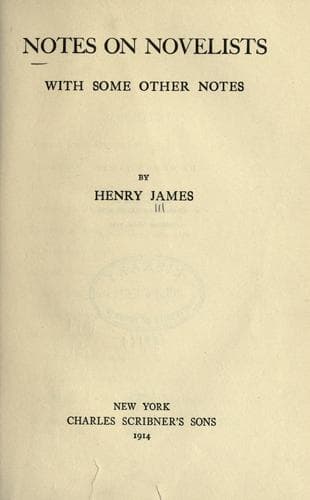
Notes on Novelists, with Some Other NotesJames, Henry
History
Notes on Novelists, with Some Other Notes
James, Henry
Fiction -- History and criticism; Novelists
Have we
in this a faint foresight of the eventual turn of the wheel—of one of
the nooks of honour, those innermost rooms of great collections, in
which our posterity shall find him? Look at him at any rate on any
occasion, but above all at his best, only long enough, and hallucination
sets in. We are in the presence of one of the prizes marked with two
stars in the guidebook; the polished floor is beneath us and the rococo
roof above; the great names are ranged about, and the eye is aware of
the near window, in its deep recess, that overhangs old gardens or a
celebrated square.
LONDON NOTES
_July_ 1897
I continued last month to seek private diversion, which I found to be
more and more required as the machinery of public began to work. Never
was a better chance apparently for the great anodyne of art. It was a
supreme opportunity to test the spell of the magician, for one felt one
was saved if a fictive world would open. I knocked in this way at a
dozen doors, I read a succession of novels; with the effect perhaps of
feeling more than ever before my individual liability in our great
general debt to the novelists. The great thing to say for them is surely
that at any given moment they offer us another world, another
consciousness, an experience that, as effective as the dentist’s ether,
muffles the ache of the actual and, by helping us to an interval, tides
us over and makes us face, in the return to the inevitable, a
combination that may at least have changed. What we get of course, in
proportion as the picture lives, is simply another actual—the actual of
other people; and I no more than any one else pretend to say _why_ that
should be a relief, a relief as great, I mean, as it practically proves.
We meet in this question, I think, the eternal mystery—the mystery that
sends us back simply to the queer constitution of man and that is not in
the least lighted by the plea of “romance,” the argument that relief
depends wholly upon the quantity, as it were, of fable. It depends, to
my sense, on the quantity of nothing but art—in which the material,
fable or fact or whatever it be, falls so into solution, is so reduced
and transmuted, that I absolutely am acquainted with no receipt whatever
for computing its proportion and amount.
Public-domain text, read in full here on John Shaqi.
Reviews
Reviews
No reviews yet
Be the first to share your thoughts on this work.
Elsewhere in the archive
Join the Discussion
Join the discussion
Sign in to leave a comment or review.
Sign InorCreate an account