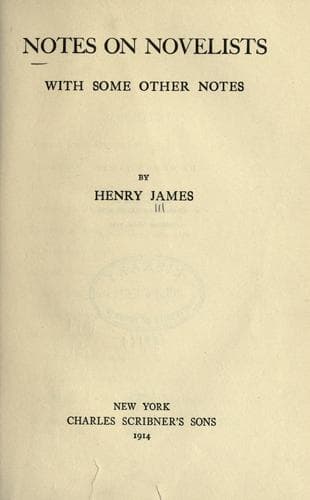
Notes on Novelists, with Some Other NotesJames, Henry
History
Notes on Novelists, with Some Other Notes
James, Henry
Fiction -- History and criticism; Novelists
The only amount I can compute is the force of the author, for that is
directly registered in my attention, my submission. A hundred things
naturally go to make it up; but he knows so much better than I what they
are that I should blush to give him a glimpse of my inferior account of
them. The anodyne is not the particular picture, it is our own act of
surrender, and therefore most, for each reader, what he most surrenders
to. This latter element would seem in turn to vary from case to case,
were it not indeed that there are readers prepared, I believe, to limit
their surrender in advance. With some, we gather, it declines for
instance to operate save on an exhibition of “high life.” In others
again it is proof against any solicitation but that of low. In many it
vibrates only to “adventure”; in many only to Charlotte Brontë; in
various groups, according to affinity, only to Jane Austen, to old
Dumas, to Miss Corelli, to Dostoievsky or whomever it may be. The
readers easiest to conceive, however, are probably those for whom, in
the whole impression, the note of sincerity in the artist is what most
matters, what most reaches and touches. That, obviously, is the relation
that gives the widest range to the anodyne.
I am afraid that, profiting by my license, I drag forward Mr. George
Gissing from an antiquity of several weeks. I blow the dust of oblivion
from M. Pierre Loti and indeed from all the company—they have been
published for days and days. I foresee, however, that I must neglect the
company for the sake of the two members I have named, writers—I speak
for myself—always in order, though not, I admit, on quite the same
line. Mr. Gissing would have been particularly in order had he only kept
for the present period the work preceding his latest; all the more that
“In the Year of Jubilee” has to my perception some points of superiority
to “The Whirlpool.” For this author in general, at any rate, I profess,
and have professed ever since reading “The New Grub Street,” a
persistent taste—a taste that triumphs even over the fact that he
almost as persistently disappoints me. I fail as yet to make out why
exactly it is that going so far he so sturdily refuses to go further.
The whole business of distribution and composition he strikes me as
having cast to the winds; but just this fact of a question about him is
a part of the wonder—I use the word in the sense of enjoyment—that he
excites. It is not every day in the year that we meet a novelist about
whom there is a question. The circumstance alone is almost sufficient to
beguile or to enthrall; and I seem to myself to have said almost
everything in speaking of something that Mr. Gissing “goes far” enough
to do. To go far enough to do anything is, in the conditions we live in,
a lively achievement.
Public-domain text, read in full here on John Shaqi.
Reviews
Reviews
No reviews yet
Be the first to share your thoughts on this work.
Elsewhere in the archive
Join the Discussion
Join the discussion
Sign in to leave a comment or review.
Sign InorCreate an account