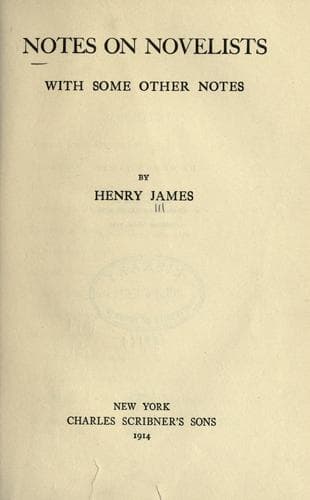
Notes on Novelists, with Some Other NotesJames, Henry
History
Notes on Novelists, with Some Other Notes
James, Henry
Fiction -- History and criticism; Novelists
“The Whirlpool,” I crudely confess, was in a manner a grief to me, but
the book has much substance, and there is no light privilege in an
emotion so sustained. This emotion perhaps it is that most makes me, to
the end, stick to Mr. Gissing—makes me with an almost nervous clutch
quite cling to him. I shall not know how to deal with him, however, if I
withhold the last outrage of calling him an interesting case. He seems
to me above all a case of saturation, and it is mainly his saturation
that makes him interesting—I mean especially in the sense of making him
singular. The interest would be greater were his art more complete; but
we must take what we can get, and Mr. Gissing has a way of his own. The
great thing is that his saturation is with elements that, presented to
us in contemporary English fiction, affect us as a product of
extraordinary oddity and rarity: he reeks with the savour, he is bowed
beneath the fruits, of contact with the lower, with the lowest
middle-class, and that is sufficient to make him an authority—_the_
authority in fact—on a region vast and unexplored.
The English novel has as a general thing kept so desperately, so
nervously clear of it, whisking back compromised skirts and bumping
frantically against obstacles to retreat, that we welcome as the boldest
of adventurers a painter who has faced it and survived. We have had low
life in plenty, for, with its sores and vices, its crimes and penalties,
misery has colour enough to open the door to any quantity of artistic
patronage. We have shuddered in the dens of thieves and the cells of
murderers, and have dropped the inevitable tear over tortured childhood
and purified sin. We have popped in at the damp cottage with my lady and
heard the quaint rustic, bless his simple heart, commit himself for our
amusement. We have fraternised on the other hand with the peerage and
the county families, staying at fine old houses till exhausted nature
has, for this source of intoxication, not a wink of sociability left. It
has grown, the source in question, as stale as the sweet biscuit with
pink enhancements in that familiar jar of the refreshment counter from
which even the attendant young lady in black, with admirers and a social
position, hesitates to extract it. We have recognised the humble, the
wretched, even the wicked; also we have recognised the “smart.” But save
under the immense pressure of Dickens we have never done anything so
dreadful as to recognise the vulgar. We have at the very most recognised
it as the extravagant, the grotesque. The case of Dickens was absolutely
special; he dealt intensely with “lower middle,” with “lowest” middle,
elements, but he escaped the predicament of showing them as vulgar by
showing them only as prodigiously droll. When his people are not funny
who shall dare to say what they are? The critic may draw breath as from
a responsibility averted when he reflects that they almost always _are_
funny.
Public-domain text, read in full here on John Shaqi.
Reviews
Reviews
No reviews yet
Be the first to share your thoughts on this work.
Elsewhere in the archive
Join the Discussion
Join the discussion
Sign in to leave a comment or review.
Sign InorCreate an account