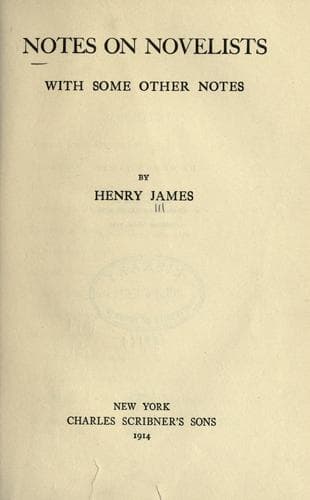
Notes on Novelists, with Some Other NotesJames, Henry
History
Notes on Novelists, with Some Other Notes
James, Henry
Fiction -- History and criticism; Novelists
They belong to a walk of life that we may be ridiculous but never
at all serious about. We may be tragic, but that is often but a form of
humour. I seem to hear Mr. Gissing say: “Well, dreariness for
dreariness, let us try Brondesbury and Pinner; especially as in the
first place I know them so well; as in the second they are the essence
of England; and as in the third they are, artistically speaking, virgin
soil. Behold them glitter in the morning dew.”
So he _is_ serious—almost imperturbably—about them, and, as it turns
out, even quite manfully and admirably sad. He has the great thing: his
saturation (with the visible and audible common) can project itself, let
him get outside of it and walk round it. I scarcely think he stays, as
it were, outside quite as much as he might; and on the question of form
he certainly strikes me as staying far too little. It is form above all
that is talent, and if Mr. Gissing’s were proportionate to his
knowledge, to what may be called his possession, we should have a larger
force to reckon with. That—not to speak of the lack of intensity in his
imagination—is the direction in which one would wish him to go further.
Our Anglo-Saxon tradition of these matters remains surely in some
respects the strangest. After the perusal of such a book as “The
Whirlpool” I feel as if I had almost to explain that by “these matters”
I mean the whole question of composition, of foreshortening, of the
proportion and relation of parts. Mr. Gissing, to wind up my reserves,
overdoes the ostensible report of spoken words; though I hasten to add
that this abuse is so general a sign, in these days, of the English and
the American novel as to deprive a challenge of every hope of credit. It
is attended visibly—that is visibly to those who can see—with two or
three woeful results. If it had none other it would still deserve
arraignment on the simple ground of what it crowds out—the golden
blocks themselves of the structure, the whole divine exercise and
mystery of the exquisite art of presentation.
Public-domain text, read in full here on John Shaqi.
Reviews
Reviews
No reviews yet
Be the first to share your thoughts on this work.
Elsewhere in the archive
Join the Discussion
Join the discussion
Sign in to leave a comment or review.
Sign InorCreate an account