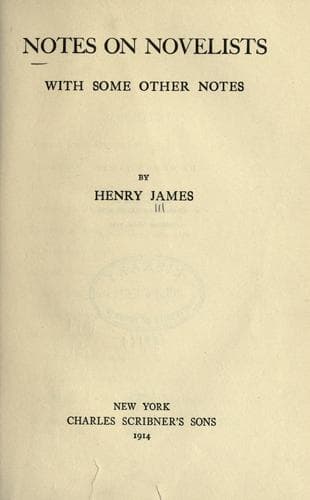
Notes on Novelists, with Some Other NotesJames, Henry
History
Notes on Novelists, with Some Other Notes
James, Henry
Fiction -- History and criticism; Novelists
The ugliest trick it plays at any rate is its effect on that side of the
novelist’s effort—the side of most difficulty and thereby of most
dignity—which consists in giving the sense of duration, of the lapse
and accumulation of time. This is altogether to my view the stiffest
problem that the artist in fiction has to tackle, and nothing is more
striking at present than the blankness, for the most part, of his
indifference to it. The mere multiplication of quoted remarks is the
last thing to strengthen his hand. Such an expedient works exactly to
the opposite end, absolutely minimising, in regard to time, our
impression of lapse and passage. That is so much the case that I can
think of no novel in which it prevails as giving at all the sense of the
gradual and the retarded—the stretch of the years in which developments
really take place. The picture is nothing unless it be a picture of the
conditions, and the conditions are usually hereby quite omitted. Thanks
to this perversity everything dealt with in fiction appears at present
to occur simply on the occasion of a few conversations about it; there
is no other constitution of it. A few hours, a few days seem to account
for it. The process, the “dark backward and abysm,” is really so little
reproduced. We feel tempted to send many an author, to learn the
rudiments of this secret, back to his Balzac again, the most
accomplished master of it. He will learn also from Balzac while he is
about it that nothing furthermore, as intrinsic effect, so much
discounts itself as this abuse of the element of colloquy.
“Dialogue,” as it is commonly called, is singularly suicidal from the
moment it is not directly illustrative of something given us by another
method, something constituted and presented. It is impossible to read
work even as interesting as Mr. Gissing’s without recognising the
impossibility of making people both talk “all the time” and talk with
the needful differences. The thing, so far as we have got, is simply too
hard. There is always at the best the author’s voice to be kept out. It
can be kept out for occasions, it can not be kept out always. The
solution therefore is to leave it its function, for it has the supreme
one. This function, properly exercised, averts the disaster of the
blight of the colloquy really in place—illustrative and indispensable.
Nothing is more inevitable than such a blight when antecedently the
general effect of the process has been undermined. We then want the
report of the spoken word—want that only. But, proportionately, it
doesn’t come, doesn’t count. It has been fatally cheapened. There is no
effect, no relief.
Public-domain text, read in full here on John Shaqi.
Reviews
Reviews
No reviews yet
Be the first to share your thoughts on this work.
Elsewhere in the archive
Join the Discussion
Join the discussion
Sign in to leave a comment or review.
Sign InorCreate an account