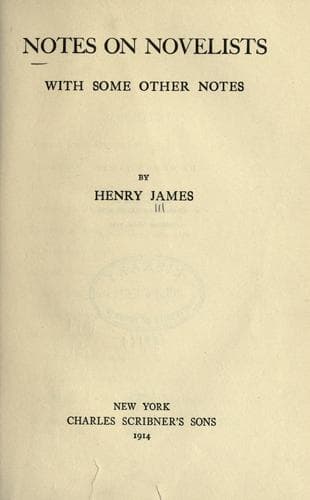
Notes on Novelists, with Some Other NotesJames, Henry
History
Notes on Novelists, with Some Other Notes
James, Henry
Fiction -- History and criticism; Novelists
I am writing a treatise when I meant only to give a glance; and it may
be asked if the best thing I find in Mr. Gissing is after all then but
an opportunity to denounce. The answer to that is that I find two other
things—or should find them rather had I not deprived myself as usual of
proper space. One of these is the pretext for speaking, by absolute
rebound, as it were, and in the interest of vivid contrast, of Pierre
Loti; the other is a better occasion still, an occasion for the
liveliest sympathy. It is impossible not to be affected by the frankness
and straightness of Mr. Gissing’s feeling for his subject, a subject
almost always distinctly remunerative to the ironic and even to the
dramatic mind. He has the strongest deepest sense of common humanity, of
the general struggle and the general grey grim comedy. He loves the
real, he renders it, and though he has a tendency to drift too much with
his tide, he gives us, in the great welter of the savourless, an
individual manly strain. If he only had distinction he would make the
suburbs “hum.” I don’t mean of course by his circulation there—the
effect Ibsen is supposed to have on them; I mean objectively and as a
rounded whole, as a great theme treated.
I am ashamed of having postponed “Ramuntcho,” for “Ramuntcho” is a
direct recall of the beauty of “Pêcheur d’Islande” and “Mon Frère
Yves”—in other words a literary impression of the most exquisite order.
Perhaps indeed it is as well that a critic _should_ postpone—and quite
indefinitely—an author as to whom he is ready to confess that his
critical instinct is quite suspended. Oh the blessing of a book, the
luxury of a talent, that one is only anxious not to reason about, only
anxious to turn over in the mind and to taste! It is a poor business
perhaps, but I have nothing more responsible to say of Loti than that I
adore him. I love him when he is bad—and heaven knows he has
occasionally been so—more than I love other writers when they are good.
If therefore he is on the whole quite at his best in “Ramuntcho” I fear
my appreciation is an undertaking too merely active for indirect
expression. I can give it no more coherent form than to say that he
makes the act of partaking one of the joys that, as things mainly go, a
reader must be pretty well provided to be able not to jump at. And yet
there are readers, apparently, who _are_ so provided. There are readers
who don’t jump and are cocksure they can do without it. My sense of the
situation is that they are wrong—that with famine stalking so abroad
literally no one can. I defy it not to tell somewhere—become a gap one
can immediately “spot.”
Public-domain text, read in full here on John Shaqi.
Reviews
Reviews
No reviews yet
Be the first to share your thoughts on this work.
Elsewhere in the archive
Join the Discussion
Join the discussion
Sign in to leave a comment or review.
Sign InorCreate an account