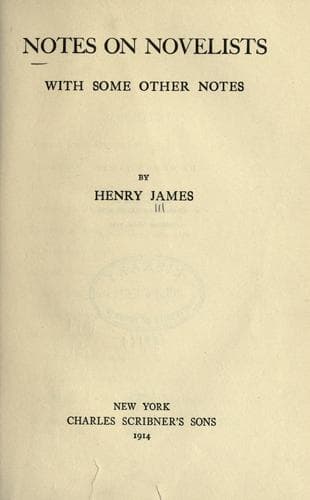
Notes on Novelists, with Some Other Notes — John Shaqi
Notes on Novelists, with Some Other NotesJames, Henry
History
Notes on Novelists, with Some Other Notes
James, Henry
Fiction -- History and criticism; Novelists
He was in prompt possession thus of the range of sympathy that he
_could_ cultivate, though it must be added that the complete exercise of
that sympathy might have encountered an obstacle that would somewhat
undermine his advantage. Our friend might have found himself able, in
other words, to pay to the instinctive, as I have called it, only such
tribute as protesting taste (his own dose of it) permitted. Yet there it
was again that fortune and his temperament served him. Taste as he knew
it, taste as his own constitution supplied it, proved to have nothing to
say to the matter. His own dose of the precious elixir had no
perceptible regulating power. Paradoxical as the remark may sound, this
accident was positively to operate as one of his greatest felicities.
There are parts of his work, those dealing with romantic or poetic
elements, in which the inactivity of the principle in question is
sufficiently hurtful; but it surely should not be described as hurtful
to such pictures as “Le Ventre de Paris,” as “L’Assommoir,” as
“Germinal.” The conception on which each of these productions rests is
that of a world with which taste has nothing to do, and though the act
of representation may be justly held, as an artistic act, to involve its
presence, the discrimination would probably have been in fact, given the
particular illusion sought, more detrimental than the deficiency. There
was a great outcry, as we all remember, over the rank materialism of
“L’Assommoir,” but who cannot see to-day how much a milder infusion of
it would have told against the close embrace of the subject aimed at?
“L’Assommoir” is the nature of man—but not his finer, nobler, cleaner
or more cultivated nature; it is the image of his free instincts, the
better and the worse, the better struggling as they can, gasping for
light and air, the worse making themselves at home in darkness,
ignorance and poverty. The whole handling makes for emphasis and scale,
and it is not to be measured how, as a picture of conditions, the thing
would have suffered from timidity. The qualification of the painter was
precisely his stoutness of stomach, and we scarce exceed in saying that
to have taken in and given out again less of the infected air would,
with such a resource, have meant the waste of a faculty.
Public-domain text, read in full here on John Shaqi.
Reviews
Reviews
No reviews yet
Be the first to share your thoughts on this work.
Join the Discussion
Join the discussion
Sign in to leave a comment or review.
Sign InorCreate an account