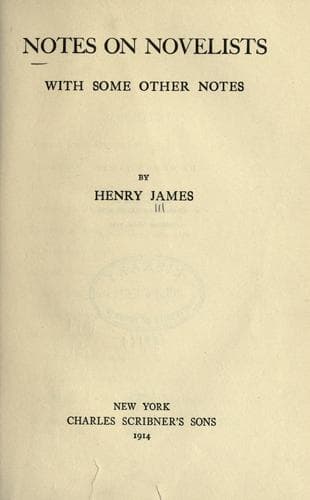
Notes on Novelists, with Some Other NotesJames, Henry
History
Notes on Novelists, with Some Other Notes
James, Henry
Fiction -- History and criticism; Novelists
But there comes back to me also as a companion-piece to this another
day, after some interval, on which the interest was excited by the fact
that the work for love of which the brave license had been taken was
actually under the ban of the daily newspaper that had engaged to
“serialise” it. Publication had definitively ceased. The thing had run a
part of its course, but it had outrun the courage of editors and the
curiosity of subscribers—that stout curiosity to which it had evidently
in such good faith been addressed. The chorus of contempt for the ways
of such people, their pusillanimity, their superficiality, vulgarity,
intellectual platitude, was the striking note on this occasion; for the
journal impugned had declined to proceed and the serial, broken off,
been obliged, if I am not mistaken, to seek the hospitality of other
columns, secured indeed with no great difficulty. The composition so
qualified for future fame was none other, as I was later to learn, than
“L’Assommoir”; and my reminiscence has perhaps no greater point than in
connecting itself with a matter always dear to the critical spirit,
especially when the latter has not too completely elbowed out the
romantic—the matter of the “origins,” the early consciousness, early
steps, early tribulations, early obscurity, as so often happens, of
productions finally crowned by time.
Their greatness is for the most part a thing that has originally begun
so small; and this impression is particularly strong when we have been
in any degree present, so to speak, at the birth. The course of the
matter is apt to tend preponderantly in that case to enrich our stores
of irony. In the eventual conquest of consideration by an abused book we
recognise, in other terms, a drama of romantic interest, a drama often
with large comic no less than with fine pathetic interweavings. It may
of course be said in this particular connection that “L’Assommoir” had
not been one of the literary things that creep humbly into the world.
Its “success” may be cited as almost insolently prompt, and the fact
remains true if the idea of success be restricted, after the inveterate
fashion, to the idea of circulation. What remains truer still, however,
is that for the critical spirit circulation mostly matters not the least
little bit, and it is of the success with which the history of Gervaise
and Coupeau nestles in _that_ capacious bosom, even as the just man
sleeps in Abraham’s, that I here speak. But it is a point I may better
refer to a moment hence.
Public-domain text, read in full here on John Shaqi.
Reviews
Reviews
No reviews yet
Be the first to share your thoughts on this work.
Join the Discussion
Join the discussion
Sign in to leave a comment or review.
Sign InorCreate an account