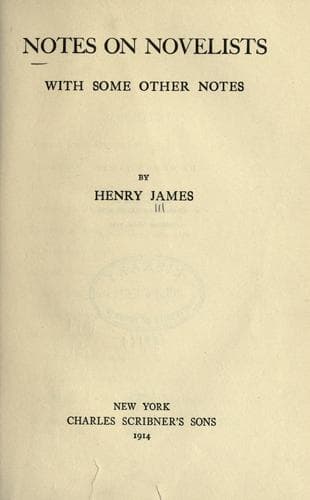
Notes on Novelists, with Some Other NotesJames, Henry
History
Notes on Novelists, with Some Other Notes
James, Henry
Fiction -- History and criticism; Novelists
To make his characters swarm, and to make the great central thing they
swarm about “as large as life,” portentously, heroically big, that was
the task he set himself very nearly from the first, that was the secret
he triumphantly mastered. Add that the big central thing was always some
highly representative institution or industry of the France of his time,
some seated Moloch of custom, of commerce, of faith, lending itself to
portrayal through its abuses and excesses, its idol-face and great
devouring mouth, and we embrace main lines of his attack. In “Le Ventre
de Paris” he had dealt with the life of the huge Halles, the general
markets and their supply, the personal forces, personal situations,
passions, involved in (strangest of all subjects) the alimentation of
the monstrous city, the city whose victualling occupies so inordinately
much of its consciousness. Paris richly gorged, Paris sublime and
indifferent in her assurance (so all unlike poor Oliver’s) of “more,”
figures here the theme itself, lies across the scene like some vast
ruminant creature breathing in a cloud of parasites. The book was the
first of the long series to show the full freedom of the author’s hand,
though “La Curée” had already been symptomatic. This freedom, after an
interval, broke out on a much bigger scale in “L’Assommoir,” in “Au
Bonheur des Dames,” in “Germinal,” in “La Bête Humaine,” in “L’Argent,”
in “La Débâcle,” and then again, though more mechanically and with much
of the glory gone, in the more or less wasted energy of “Lourdes,”
“Rome,” “Paris,” of “Fécondité,” “Travail” and “Vérité.”
Public-domain text, read in full here on John Shaqi.
Reviews
Reviews
No reviews yet
Be the first to share your thoughts on this work.
Join the Discussion
Join the discussion
Sign in to leave a comment or review.
Sign InorCreate an account