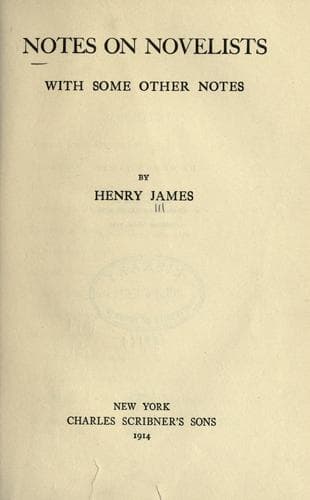
Notes on Novelists, with Some Other NotesJames, Henry
History
Notes on Novelists, with Some Other Notes
James, Henry
Fiction -- History and criticism; Novelists
“Au Bonheur des Dames” handles the colossal modern shop, traces the
growth of such an organisation as the Bon Marché or the
Magasin-du-Louvre, sounds the abysses of its inner life, marshals its
population, its hierarchy of clerks, counters, departments, divisions
and sub-divisions, plunges into the labyrinth of the mutual relations of
its staff, and above all traces its ravage amid the smaller fry of the
trade, of all the trades, pictures these latter gasping for breath in an
air pumped clean by its mighty lungs. “Germinal” revolves about the
coal-mines of Flemish France, with the subterranean world of the pits
for its central presence, just as “La Bête Humaine” has for its
protagonist a great railway and “L’Argent” presents in terms of human
passion—mainly of human baseness—the fury of the Bourse and the
monster of Credit. “La Débâcle” takes up with extraordinary breadth the
first act of the Franco-Prussian war, the collapse at Sedan, and the
titles of the six volumes of The Three Cities and the Four Gospels
sufficiently explain them. I may mention, however, for the last
lucidity, that among these “Fécondité” manipulates, with an amazing
misapprehension of means to ends, of remedies to ills, no less thickly
peopled a theme than that of the decline in the French birth-rate, and
that “Vérité” presents a fictive equivalent of the Dreyfus case, with a
vast and elaborate picture of the battle in France between lay and
clerical instruction. I may even further mention, to clear the ground,
that with the close of Les Rougon-Macquart the diminution of freshness
in the author’s energy, the diminution of intensity and, in short, of
quality, becomes such as to render sadly difficult a happy life with
some of the later volumes. Happiness of the purest strain never indeed,
in old absorptions of Zola, quite sat at the feast; but there was mostly
a measure of coercion, a spell without a charm. From these last-named
productions of the climax everything strikes me as absent but quantity
(“Vérité,” for instance, is, with the possible exception of “Nana,” the
longest of the list); though indeed there is something impressive in the
way his quantity represents his patience.
Public-domain text, read in full here on John Shaqi.
Reviews
Reviews
No reviews yet
Be the first to share your thoughts on this work.
Join the Discussion
Join the discussion
Sign in to leave a comment or review.
Sign InorCreate an account