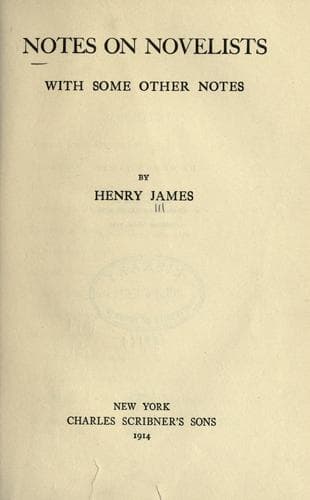
Notes on Novelists, with Some Other NotesJames, Henry
History
Notes on Novelists, with Some Other Notes
James, Henry
Fiction -- History and criticism; Novelists
particular shade of blindness that could constitute a trap for so great
an artistic intelligence. The presumptuous volume, without sweetness,
without antecedents, superficial and violent, has the minimum instead of
the maximum of _value_; so that it betrayed or “gave away” just in this
degree the state of mind on the author’s part responsible for its
inflated hollowness. To put one’s finger on the state of mind was to
find out accordingly what was, as we say, the matter with him.
It seemed to me, I remember, that I found out as never before when, in
its turn, “Fécondité” began the work of crowning the edifice.
“Fécondité” is physiological, whereas “Rome” is not, whereas “Vérité”
likewise is not; yet these three productions joined hands at a given
moment to fit into the lock of the mystery the key of my meditation.
They came to the same thing, to the extent of permitting me to read into
them together the same precious lesson. This lesson may not, barely
stated, sound remarkable; yet without being in possession of it I should
have ventured on none of these remarks. “The matter with” Zola then, so
far as it goes, was that, as the imagination of the artist is in the
best cases not only clarified but intensified by his equal possession of
Taste (deserving here if ever the old-fashioned honour of a capital) so
when he has lucklessly never inherited that auxiliary blessing the
imagination itself inevitably breaks down as a consequence. There is
simply no limit, in fine, to the misfortune of being tasteless; it does
not merely disfigure the surface and the fringe of your performance—it
eats back into the very heart and enfeebles the sources of life. When
you have no taste you have no discretion, which is the conscience of
taste, and when you have no discretion you perpetrate books like “Rome,”
which are without intellectual modesty, books like “Fécondité,” which
are without a sense of the ridiculous, books like “Vérité,” which are
without the finer vision of human experience.
Public-domain text, read in full here on John Shaqi.
Reviews
Reviews
No reviews yet
Be the first to share your thoughts on this work.
Join the Discussion
Join the discussion
Sign in to leave a comment or review.
Sign InorCreate an account