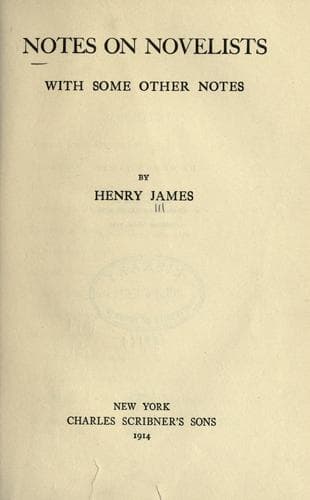
Notes on Novelists, with Some Other NotesJames, Henry
History
Notes on Novelists, with Some Other Notes
James, Henry
Fiction -- History and criticism; Novelists
It was splendid for confidence and cheer, but it left me, I fear, more
or less gaping, and it was to give me afterwards the key, critically
speaking, to many a mystery. It struck me as breathing to an almost
tragic degree the fatuity of those in whom the gods stimulate that vice
to their ruin. He was an honest man—he had always bristled with it at
every pore; but no artistic reverse was inconceivable for an adventurer
who, stating in one breath that his knowledge of Italy consisted of a
few days spent at Genoa, was ready to declare in the next that he had
planned, on a scale, a picture of Rome. It flooded his career, to my
sense, with light; it showed how he had marched from subject to subject
and had “got up” each in turn—showing also how consummately he had
reduced such getting-up to an artifice. He had success and a rare
impunity behind him, but nothing would now be so interesting as to see
if he could again play the trick. One would leave him, and welcome,
Lourdes and Paris—he had already dealt, on a scale, with his own
country and people. But was the adored Rome also to be his on such
terms, the Rome he was already giving away before possessing an inch of
it? One thought of one’s own frequentations, saturations—a history of
long years, and of how the effect of them had somehow been but to make
the subject too august. Was _he_ to find it easy through a visit of a
month or two with “introductions” and a Bædeker?
It was not indeed that the Bædeker and the introductions didn’t show, to
my sense, at that hour, as extremely suggestive; they were positively a
part of the light struck out by his announcement. They defined the
system on which he had brought Les Rougon-Macquart safely into port. He
had had his Bædeker and his introductions for “Germinal,” for
“L’Assommoir,” for “L’Argent,” for “La Débâcle,” for “Au Bonheur des
Dames”; which advantages, which researches, had clearly been all the
more in character for being documentary, extractive, a matter of
_renseignements_, published or private, even when most mixed with
personal impressions snatched, with _enquêtes sur les lieux_, with facts
obtained from the best authorities, proud and happy to co-operate in so
famous a connection. That was, as we say, all right, all the more that
the process, to my imagination, became vivid and was wonderfully
reflected back from its fruits. There _were_ the fruits—so it hadn’t
been presumptuous. Presumption, however, was now to begin, and what omen
mightn’t there be in its beginning with such complacency? Well, time
would show—as time in due course effectually did. “Rome,” as the second
volume of The Three Cities, appeared with high punctuality a year or two
later; and the interesting question, an occasion really for the
moralist, was by that time not to recognise in it the mere triumph of a
mechanical art, a “receipt” applied with the skill of long practice, but
to do much more than this—that is really to give a name to the
Public-domain text, read in full here on John Shaqi.
Reviews
Reviews
No reviews yet
Be the first to share your thoughts on this work.
Join the Discussion
Join the discussion
Sign in to leave a comment or review.
Sign InorCreate an account