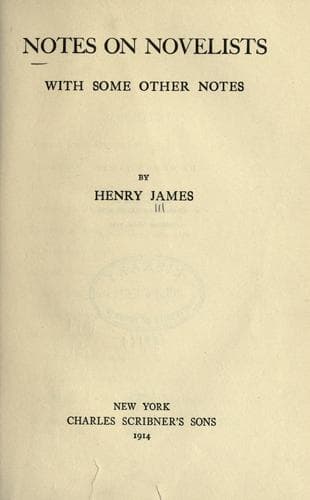
Notes on Novelists, with Some Other NotesJames, Henry
History
Notes on Novelists, with Some Other Notes
James, Henry
Fiction -- History and criticism; Novelists
appearances; and the general knot so presented is indeed a hard one to
untie. Yet we may take it for a matter regarding which such publications
as Mr. Colvin’s have much to suggest.
There is no absolute privacy—save of course when the exposed subject
may have wished or endeavoured positively to constitute it; and things
too sacred are often only things that are not perhaps at all otherwise
superlative. One may hold both that people—that artists perhaps in
particular—are well advised to cover their tracks, and yet that our
having gone behind, or merely stayed before, in a particular case, may
be a minor question compared with our having picked up a value. Personal
records of the type before us can at any rate obviously be but the
reverse of a deterrent to the urged inquirer. They are too happy an
instance—they positively make for the risked indiscretion. Stevenson
never covered his tracks, and the tracks prove perhaps to be what most
attaches us. We follow them here, from year to year and from stage to
stage, with the same charmed sense with which he has made us follow some
hunted hero in the heather. Life and fate and an early catastrophe were
ever at his heels, and when he at last falls fighting, sinks down in the
very act of valour, the “happy ending,” as he calls it for some of his
correspondents, is, though precipitated and not conventional,
essentially given us.
His descent and his origin all contribute to the picture, which it seems
to me could scarce—since we speak of “endings”—have had a better
beginning had he himself prearranged it. Without prearrangements indeed
it was such a cluster of terms as could never be wasted on him, one of
those innumerable matters of “effect,” Scotch and other, that helped to
fill his romantic consciousness. Edinburgh, in the first place, the
“romantic town,” was as much his “own” as it ever was the great
precursor’s whom, in “Weir of Hermiston” as well as elsewhere, he
presses so hard; and this even in spite of continual absence—in virtue
of a constant imaginative reference and an intense intellectual
possession. The immediate background formed by the profession of his
family—the charge of the public lights on northern coasts—was a
setting that he could not have seen his way to better; while no less
happy a condition was met by his being all lonely in his father’s
house—the more that the father, admirably commemorated by the son and
after his fashion as strongly marked, was antique and strenuous, and
that the son, a genius to be and of frail constitution, was (in the
words of the charming anecdote of an Edinburgh lady retailed in one of
these volumes), if not exactly what could be called bonny, “pale,
penetrating and interesting.” The poet in him had from the first to be
pacified—temporarily, that is, and from hand to mouth, as is the manner
for poets; so that with friction and tension playing their part, with
the filial relation quite classically troubled, with breaks of tradition
Public-domain text, read in full here on John Shaqi.
Reviews
Reviews
No reviews yet
Be the first to share your thoughts on this work.
Join the Discussion
Join the discussion
Sign in to leave a comment or review.
Sign InorCreate an account