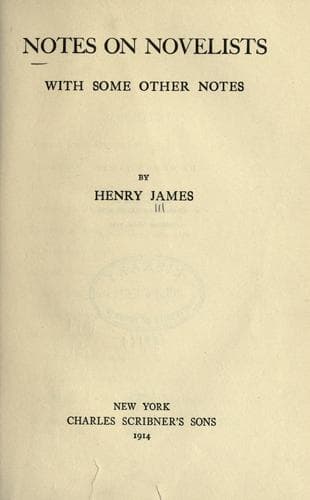
Notes on Novelists, with Some Other NotesJames, Henry
History
Notes on Novelists, with Some Other Notes
James, Henry
Fiction -- History and criticism; Novelists
Grant—and the generalisation may be emphatic—that the shallow and the
simple are _all_ the population of his richest and most crowded
pictures, and that his “psychology,” in a psychologic age, remains
thereby comparatively coarse, grant this and we but get another view of
the miracle. We see enough of the superficial among novelists at large,
assuredly, without deriving from it, as we derive from Zola at his best,
the concomitant impression of the solid. It is in general—I mean among
the novelists at large—the impression of the _cheap_, which the author
of Les Rougon-Macquart, honest man, never faithless for a moment to his
own stiff standard, manages to spare us even in the prolonged sandstorm
of “Vérité.” The Common is another matter; it is one of the forms of the
superficial—pervading and consecrating all things in such a book as
“Germinal”—and it only adds to the number of our critical questions.
How in the world is it made, this deplorable democratic malodorous
Common, so strange and so interesting? How is it taught to receive into
its loins the stuff of the epic and still, in spite of that association
with poetry, never depart from its nature? It is in the great lusty game
he plays with the shallow and the simple that Zola’s mastery resides,
and we see of course that when values are small it takes innumerable
items and combinations to make up the sum. In “L’Assommoir” and in
“Germinal,” to some extent even in “La Débâcle,” the values are all,
morally, personally, of the lowest—the highest is poor Gervaise
herself, richly human in her generosities and follies—yet each is as
distinct as a brass-headed nail.
Public-domain text, read in full here on John Shaqi.
Reviews
Reviews
No reviews yet
Be the first to share your thoughts on this work.
Join the Discussion
Join the discussion
Sign in to leave a comment or review.
Sign InorCreate an account