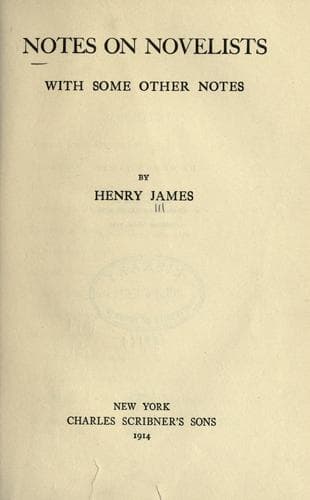
Notes on Novelists, with Some Other NotesJames, Henry
History
Notes on Novelists, with Some Other Notes
James, Henry
Fiction -- History and criticism; Novelists
What we come back to accordingly is the unprecedented case of such a
combination of parts. Painters, of great schools, often of great talent,
have responded liberally on canvas to the appeal of ugly things, of
Spanish beggars, squalid and dusty-footed, of martyred saints or other
convulsed sufferers, tortured and bleeding, of boors and louts soaking a
Dutch proboscis in perpetual beer; but we had never before had to reckon
with so literary a treatment of the mean and vulgar. When we others of
the Anglo-Saxon race are vulgar we are, handsomely and with the best
conscience in the world, vulgar all through, too vulgar to be in any
degree literary, and too much so therefore to be critically reckoned
with at all. The French are different—they separate their sympathies,
multiply their possibilities, observe their shades, remain more or less
outside of their worst disasters. They mostly contrive to get the
_idea_, in however dead a faint, down into the lifeboat. They may lose
sight of the stars, but they save in some such fashion as that their
intellectual souls. Zola’s own reply to all puzzlements would have been,
at any rate, I take it, a straight summary of his inveterate
professional habits. “It is all very simple—I produce, roughly
speaking, a volume a year, and of this time some five months go to
preparation, to special study. In the other months, with all my _cadres_
established, I write the book. And I can hardly say which part of the
job is stiffest.”
The story was not more wonderful for him than that, nor the job more
complex; which is why we must say of his whole process and its results
that they constitute together perhaps the most extraordinary _imitation_
of observation that we possess. Balzac appealed to “science” and
proceeded by her aid; Balzac had _cadres_ enough and a tabulated world,
rubrics, relationships and genealogies; but Balzac affects us in spite
of everything as personally overtaken by life, as fairly hunted and run
to earth by it. He strikes us as struggling and all but submerged, as
beating over the scene such a pair of wings as were not soon again to be
wielded by any visitor of his general air and as had not at all events
attached themselves to Zola’s rounded shoulders. His bequest is in
consequence immeasurably more interesting, yet who shall declare that
his adventure was in its greatness more successful? Zola “pulled it
off,” as we say, supremely, in that he never but once found himself
obliged to quit, to our vision, his magnificent treadmill of the
pigeonholed and documented—the region we may qualify as that of
experience by imitation. His splendid economy saw him through, he
laboured to the end within sight of his notes and his charts.
Public-domain text, read in full here on John Shaqi.
Reviews
Reviews
No reviews yet
Be the first to share your thoughts on this work.
Join the Discussion
Join the discussion
Sign in to leave a comment or review.
Sign InorCreate an account