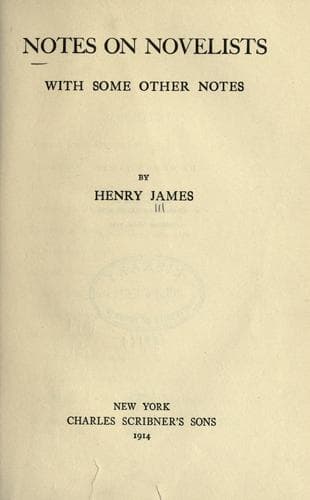
Notes on Novelists, with Some Other NotesJames, Henry
History
Notes on Novelists, with Some Other Notes
James, Henry
Fiction -- History and criticism; Novelists
We meet Frédéric first, we remain with him long, as a _moyen_, a
provincial bourgeois of the mid-century, educated and not without
fortune, thereby with freedom, in whom the life of his day reflects
itself. Yet the life of his day, on Flaubert’s showing, hangs together
with the poverty of Frédéric’s own inward or for that matter outward
life; so that, the whole thing being, for scale, intention and
extension, a sort of epic of the usual (with the Revolution of 1848
introduced indeed as an episode,) it affects us as an epic without air,
without wings to lift it; reminds us in fact more than anything else of
a huge balloon, all of silk pieces strongly sewn together and patiently
blown up, but that absolutely refuses to leave the ground. The
discrimination I here make as against our author is, however, the only
one inevitable in a series of remarks so brief. What it really
represents—and nothing could be more curious—is that Frédéric enjoys
his position not only without the aid of a single “sympathetic”
character of consequence, but even without the aid of one with whom we
can directly communicate. Can we communicate with the central personage?
or would we really if we could? A hundred times no, and if he himself
can communicate with the people shown us as surrounding him this only
proves him of their kind. Flaubert on his “real” side was in truth an
ironic painter, and ironic to a tune that makes his final accepted
state, his present literary dignity and “classic” peace, superficially
anomalous. There is an explanation to which I shall immediately come;
but I find myself feeling for a moment longer in presence of
“L’Éducation” how much more interesting a writer may be on occasion by
the given failure than by the given success. Successes pure and simple
disconnect and dismiss him; failures—though I admit they must be a bit
qualified—keep him in touch and in relation. Thus it is that as the
work of a “grand écrivain” “L’Éducation,” large, laboured, immensely
“written,” with beautiful passages and a general emptiness, with a kind
of leak in its stored sadness, moreover, by which its moral dignity
escapes—thus it is that Flaubert’s ill-starred novel is a curiosity for
a literary museum. Thus it is also that it suggests a hundred
reflections, and suggests perhaps most of them directly to the intending
labourer in the same field. If in short, as I have said, Flaubert is the
novelist’s novelist, this performance does more than any other toward
making him so.
Public-domain text, read in full here on John Shaqi.
Reviews
Reviews
No reviews yet
Be the first to share your thoughts on this work.
Elsewhere in the archive
Join the Discussion
Join the discussion
Sign in to leave a comment or review.
Sign InorCreate an account