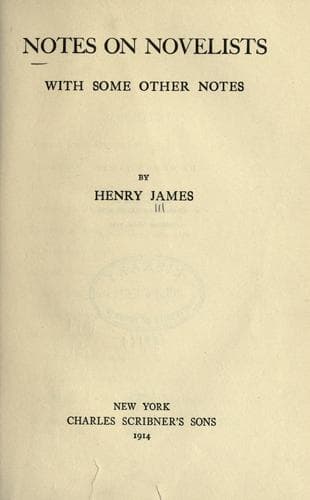
Notes on Novelists, with Some Other NotesJames, Henry
History
Notes on Novelists, with Some Other Notes
James, Henry
Fiction -- History and criticism; Novelists
I have to add in the same connection that I had not lost sight of Madame
Arnoux, the main ornament of “L’Éducation,” in pronouncing just above on
its deficiency in the sympathetic. Madame Arnoux is exactly the author’s
one marked attempt, here or elsewhere, to represent beauty otherwise
than for the senses, beauty of character and life; and what becomes of
the attempt is a matter highly significant. M. Faguet praises with
justice his conception of the figure and of the relation, the relation
that never bears fruit, that keeps Frédéric adoring her, through
hindrance and change, from the beginning of life to the end; that keeps
her, by the same constraint, forever immaculately “good,” from youth to
age, though deeply moved and cruelly tempted and sorely tried. Her
contacts with her adorer are not even frequent, in proportion to the
field of time; her conditions of fortune, of association and occupation
are almost sordid, and we see them with the march of the drama, such as
it is, become more and more so; besides which—I again remember that M.
Faguet excellently notes it—nothing in the nature of “parts” is
attributed to her; not only is she not presented as clever, she is
scarce invested with a character at all. Almost nothing that she says is
repeated, almost nothing that she does is shown. She is an image none
the less beautiful and vague, an image of passion cherished and abjured,
renouncing all sustenance and yet persisting in life. Only she has for
real distinction the extreme drawback that she is offered us quite
preponderantly through Frédéric’s vision of her, that we see her
practically in no other light. Now Flaubert unfortunately has not been
able not so to discredit Frédéric’s vision in general, his vision of
everyone and everything, and in particular of his own life, that it
makes a medium good enough to convey adequately a noble impression.
Madame Arnoux is of course ever so much the best thing in his
life—which is saying little; but his life is made up of such queer
material that we find ourselves displeased at her being “in” it on
whatever terms; all the more that she seems scarcely to affect, improve
or determine it. Her creator in short never had a more awkward idea than
this attempt to give us the benefit of such a conception in such a way;
and even though I have still something else to say about that I may as
well speak of it at once as a mistake that gravely counts against him.
It is but one of three, no doubt, in all his work; but I shall not, I
trust, pass for extravagant if I call it the most indicative. What makes
it so is its being the least superficial; the two others are, so to
speak, intellectual, while this is somehow moral. It was a mistake, as I
have already hinted, to propose to register in so mean a consciousness
as that of such a hero so large and so mixed a quantity of life as
“L’Éducation” clearly intends; and it was a mistake of the tragic sort
that is a theme mainly for silence to have embarked on “Bouvard et
Public-domain text, read in full here on John Shaqi.
Reviews
Reviews
No reviews yet
Be the first to share your thoughts on this work.
Elsewhere in the archive
Join the Discussion
Join the discussion
Sign in to leave a comment or review.
Sign InorCreate an account