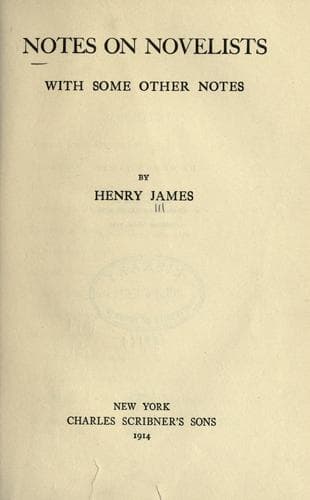
Notes on Novelists, with Some Other NotesJames, Henry
History
Notes on Novelists, with Some Other Notes
James, Henry
Fiction -- History and criticism; Novelists
Pécuchet” at all, not to have given it up sooner than be given up by it.
But these were at the worst not wholly compromising blunders. What _was_
compromising—and the great point is that it remained so, that nothing
has an equal weight against it—is the unconsciousness of error in
respect to the opportunity that would have counted as his finest. We
feel not so much that Flaubert misses it, for that we could bear; but
that he doesn’t _know_ he misses it is what stamps the blunder. We do
not pretend to say how he might have shown us Madame Arnoux better—that
was his own affair. What is ours is that he really thought he was
showing her as well as he could, or as she might be shown; at which we
veil our face. For once that he had a conception quite apart, apart I
mean from the array of his other conceptions and more delicate than any,
he “went,” as we say, and spoiled it. Let me add in all tenderness, and
to make up for possibly too much insistence, that it is the only stain
on his shield; let me even confess that I should not wonder if, when all
is said, it is a blemish no one has ever noticed.
Perhaps no one has ever noticed either what was present to me just above
as the partial makeweight there glanced at, the fact that in the midst
of this general awkwardness, as I have called it, there is at the same
time a danger so escaped as to entitle our author to full credit. I
scarce know how to put it with little enough of the ungracious, but I
think that even the true Flaubertist finds himself wondering a little
that some flaw of taste, some small but unfortunate lapse by the way,
_should_ as a matter of fact not somehow or somewhere have waited on the
demonstration of the platonic purity prevailing between this heroine and
her hero—so far as we do find that image projected. It is alike
difficult to indicate without offence or to ignore without unkindness a
fond reader’s apprehension here of a possibility of the wrong touch, the
just perceptibly false note. I would not have staked my life on
Flaubert’s security of instinct in such a connection—as an absolutely
fine and predetermined security; and yet in the event that felicity has
settled, there is not so much as the lightest wrong breath (speaking of
the matter in this light of tact and taste) or the shade of a crooked
stroke. One exclaims at the end of the question “Dear old Flaubert after
all—!” and perhaps so risks seeming to patronise for fear of not making
a point. The point made for what it is worth, at any rate, I am the more
free to recover the benefit of what I mean by critical “tenderness” in
our general connection—expressing in it as I do our general respect,
and my own particular, for our author’s method and process and history,
and my sense of the luxury of such a sentiment at such a vulgar literary
time. It is a respect positive and settled and the thing that has most
to do with consecrating for us that loyalty to him as the novelist of
Public-domain text, read in full here on John Shaqi.
Reviews
Reviews
No reviews yet
Be the first to share your thoughts on this work.
Elsewhere in the archive
Join the Discussion
Join the discussion
Sign in to leave a comment or review.
Sign InorCreate an account