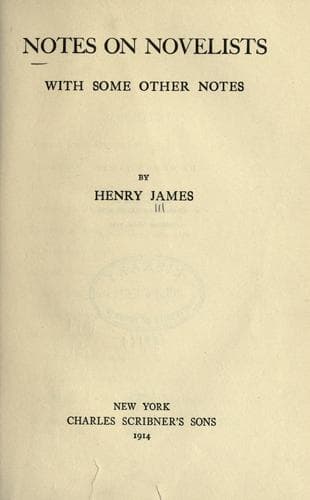
Notes on Novelists, with Some Other NotesJames, Henry
History
Notes on Novelists, with Some Other Notes
James, Henry
Fiction -- History and criticism; Novelists
the novelist—unlike as it is even the best feeling inspired by any
other member of the craft. He may stand for our operative conscience or
our vicarious sacrifice; animated by a sense of literary honour,
attached to an ideal of perfection, incapable of lapsing in fine from a
self-respect, that enable us to sit at ease, to surrender to the age, to
indulge in whatever comparative meannesses (and no meanness in art is so
mean as the sneaking economic,) we may find most comfortable or
profitable. May it not in truth be said that we practise our industry,
so many of us, at relatively little cost just _because_ poor Flaubert,
producing the most expensive fictions ever written, so handsomely paid
for it? It is as if this put it in our power to produce cheap and
thereby sell dear; as if, so expressing it, literary honour being by his
example effectively secure for the firm at large and the general
concern, on its whole esthetic side, floated once for all, we find our
individual attention free for literary and esthetic indifference. All
the while we thus lavish our indifference the spirit of the author of
“Madame Bovary,” in the cross-light of the old room above the Seine, is
trying to the last admiration for the thing itself. That production puts
the matter into a nutshell: “Madame Bovary,” subject to whatever
qualification, is absolutely the most literary of novels, so literary
that it covers us with its mantle. It shows us once for all that there
is no _intrinsic_ call for a debasement of the type. The mantle I speak
of is wrought with surpassing fineness, and we may always, under stress
of whatever charge of illiteracy, frivolity, vulgarity, flaunt it as the
flag of the guild. Let us therefore frankly concede that to surround
Flaubert with our consideration is the least return we can make for such
a privilege. The consideration moreover is idle unless it be real,
unless it be intelligent enough to measure his effort and his success.
Of the effort as mere effort I have already spoken, of the desperate
difficulty involved for him in making his form square with his
conception; and I by no means attach general importance to these secrets
of the workshop, which are but as the contortions of the fastidious muse
who is the servant of the oracle. They are really rather secrets of the
kitchen and contortions of the priestess of _that_ tripod—they are not
an upstairs matter. It is of their specially distinctive importance I am
now speaking, of the light shed on them by the results before us.
Public-domain text, read in full here on John Shaqi.
Reviews
Reviews
No reviews yet
Be the first to share your thoughts on this work.
Elsewhere in the archive
Join the Discussion
Join the discussion
Sign in to leave a comment or review.
Sign InorCreate an account