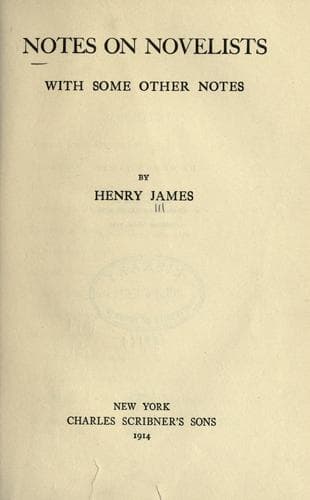
Notes on Novelists, with Some Other NotesJames, Henry
History
Notes on Novelists, with Some Other Notes
James, Henry
Fiction -- History and criticism; Novelists
They all represent the pursuit of a style, of the ideally right one for
its relations, and would still be interesting if the style had not been
achieved. “Madame Bovary,” “Salammbô,” “Saint-Antoine,” “L’Éducation”
are so written and so composed (though the last-named in a minor degree)
that the more we look at them the more we find in them, under this head,
a beauty of intention and of effect; the more they figure in the too
often dreary desert of fictional prose a class by themselves and a
little living oasis. So far as that desert is of the complexion of our
own English speech it supplies with remarkable rarity this particular
source of refreshment. So strikingly is that the case, so scant for the
most part any dream of a scheme of beauty in these connections, that a
critic betrayed at artless moments into a plea for composition may find
himself as blankly met as if his plea were for trigonometry. He makes
inevitably his reflections, which are numerous enough; one of them being
that if we turn our back so squarely, so universally to this order of
considerations it is because the novel is so preponderantly cultivated
among us by women, in other words by a sex ever gracefully, comfortably,
enviably unconscious (it would be too much to call them even
suspicious,) of the requirements of form. The case is at any rate
sharply enough made for us, or against us, by the circumstance that
women are held to have achieved on all our ground, in spite of this
weakness and others, as great results as any. The judgment is
undoubtedly founded: Jane Austen was instinctive and charming, and the
other recognitions—even over the heads of the ladies, some of them,
from Fielding to Pater—are obvious; without, however, in the least
touching my contention. For signal examples of what composition,
distribution, arrangement can do, of how they intensify the life of a
work of art, we have to go elsewhere; and the value of Flaubert for us
is that he admirably points the moral. This is the explanation of the
“classic” fortune of “Madame Bovary” in especial, though I may add that
also of Hérodias and Saint-Julien l’Hospitalier in the “Trois Contes,”
as well as an aspect of these works endlessly suggestive. I spoke just
now of the small field of the picture in the longest of them, the small
capacity, as I called it, of the vessel; yet the way the thing is done
not only triumphs over the question of value but in respect to it fairly
misleads and confounds us. Where else shall we find in anything
proportionately so small such an air of dignity of size? Flaubert _made_
things big—it was his way, his ambition and his necessity; and I say
this while remembering that in “L’Éducation” (in proportion I mean
again,) the effect has not been produced. The subject of “L’Éducation”
is in spite of Frédéric large, but an indefinable shrinkage has
overtaken it in the execution. The exception so marked, however, is
single; “Salammbô” and “Saint-Antoine” are both at once very “heavy”
Public-domain text, read in full here on John Shaqi.
Reviews
Reviews
No reviews yet
Be the first to share your thoughts on this work.
Elsewhere in the archive
Join the Discussion
Join the discussion
Sign in to leave a comment or review.
Sign InorCreate an account