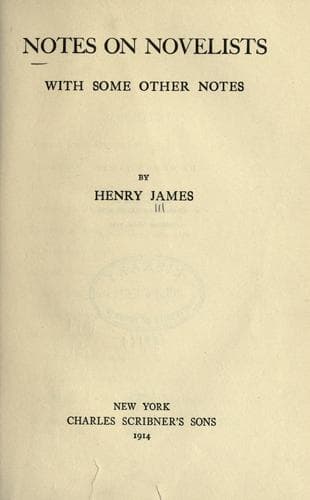
Notes on Novelists, with Some Other NotesJames, Henry
History
Notes on Novelists, with Some Other Notes
James, Henry
Fiction -- History and criticism; Novelists
conceptions and very consistently and splendidly high applications of a
manner.
It is in this assured manner that the lesson sits aloft, that the spell
for the critical reader resides; and if the conviction under which
Flaubert labours is more and more grossly discredited among us his
compact mass is but the greater. He regarded the work of art as
_existing_ but by its expression, and defied us to name any other
measure of its life that is not a stultification. He held style to be
accordingly an indefeasible part of it, and found beauty, interest and
distinction as dependent on it for emergence as a letter committed to
the post-office is dependent on an addressed envelope. Strange enough it
may well appear to us to have to apologise for such notions as
eccentric. There are persons who consider that style comes of itself—we
see and hear at present, I think, enough of them; and to whom he would
doubtless have remarked that it goes, of itself, still faster. The thing
naturally differs in fact with the nature of the imagination; the
question is one of proprieties and affinities, sympathy and proportion.
The sympathy of the author of “Salammbô” was all with the magnificent,
his imagination for the phrase as variously noble or ignoble in itself,
contribute or destructive, adapted and harmonious or casual and common.
The worse among such possibilities have been multiplied by the infection
of bad writing, and he denied that the better ever do anything so
obliging as to come of themselves. They scarcely indeed for Flaubert
“came” at all; their arrival was determined only by fasting and prayer
or by patience of pursuit, the arts of the chase, long waits and
watches, figuratively speaking, among the peaks or by the waters. The
production of a book was of course made inordinately slow by the fatigue
of these measures; in illustration of which his letters often record
that it has taken him three days[3] to arrive at one right sentence,
tested by the pitch of his ideal of the right for the suggestion aimed
at. His difficulties drew from the author, as I have mentioned, much
resounding complaint; but those voices have ceased to trouble us and the
final voice remains. No feature of the whole business is more edifying
than the fact that he in the first place never misses style and in the
second never appears to have beaten about for it. That betrayal is of
course the worst betrayal of all, and I think the way he has escaped it
the happiest form of the peace that has finally visited him. It was
truly a wonderful success to be so the devotee of the phrase and yet
never its victim. Fine as he inveterately desired it should be he still
never lost sight of the question Fine for what? It is always so related
and associated, so properly part of something else that is in turn part
of something other, part of a reference, a tone, a passage, a page, that
the simple may enjoy it for its least bearing and the initiated for its
greatest.
Public-domain text, read in full here on John Shaqi.
Reviews
Reviews
No reviews yet
Be the first to share your thoughts on this work.
Elsewhere in the archive
Join the Discussion
Join the discussion
Sign in to leave a comment or review.
Sign InorCreate an account