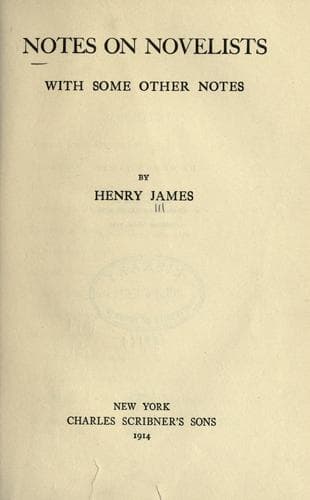
Notes on Novelists, with Some Other NotesJames, Henry
History
Notes on Novelists, with Some Other Notes
James, Henry
Fiction -- History and criticism; Novelists
That surely is to be a writer of the first order, to resemble
when in the hand and however closely viewed a shapely crystal box, and
yet to be seen when placed on the table and opened to contain
innumerable compartments, springs and tricks. One is ornamental either
way, but one is in the second way precious too.
The crystal box then figures the style of “Salammbô” and “Saint-Antoine”
in a greater degree than that of “Bovary,” because, as the two former
express the writer’s romantic side, he had in them, while equally
covering his tracks, still further to fare and still more to hunt.
Beyond this allusion to their completing his duality I shall not attempt
closely to characterise them; though I admit that in not insisting on
them I press most lightly on the scale into which he had in his own view
cast his greatest pressure. He lamented the doom that drove him so
oddly, so ruefully, to choose his subjects, but he lamented it least
when these subjects were most pompous and most exotic, feeling as he did
that they had then after all most affinity with his special eloquence.
In dealing with the near, the directly perceived, he had to keep down
his tone, to make the eloquence small; though with the consequence, as
we have seen, that in spite of such precautions the whole thing mostly
insists on being ample. The familiar, that is, under his touch, took on
character, importance, extension, one scarce knows what to call it, in
order to carry the style or perhaps rather, as we may say, sit with
proper ease in the vehicle, and there was accordingly a limit to its
smallness; whereas in the romantic books, the preferred world of
Flaubert’s imagination, there was practically no need of compromise. The
compromise gave him throughout endless trouble, and nothing would be
more to the point than to show, had I space, why in particular it
distressed him. It was obviously his strange predicament that the only
spectacle open to him by experience and direct knowledge was the
bourgeois, which on that ground imposed on him successively his three so
intensely bourgeois themes. He was obliged to treat these themes, which
he hated, because his experience left him no alternative; his only
alternative was given by history, geography, philosophy, fancy, the
world of erudition and of imagination, the world especially of this
last. In the bourgeois sphere his ideal of expression laboured under
protest; in the other, the imagined, the projected, his need for facts,
for matter, and his pursuit of them, sat no less heavily. But as his
style all the while required a certain exercise of pride he was on the
whole more at home in the exotic than in the familiar; he escaped above
all in the former connection the associations, the disparities he
detested. He could be frankly noble in “Salammbô” and “Saint-Antoine,”
whereas in “Bovary” and “L’Éducation” he could be but circuitously and
insidiously so. He could in the one case cut his coat according to his
Public-domain text, read in full here on John Shaqi.
Reviews
Reviews
No reviews yet
Be the first to share your thoughts on this work.
Elsewhere in the archive
Join the Discussion
Join the discussion
Sign in to leave a comment or review.
Sign InorCreate an account