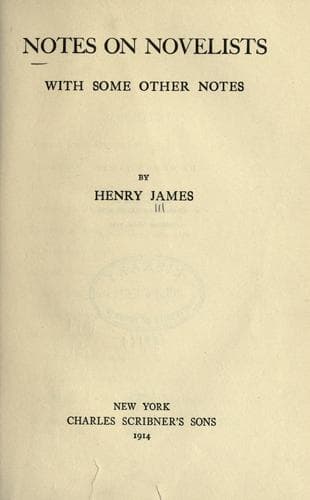
Notes on Novelists, with Some Other NotesJames, Henry
History
Notes on Novelists, with Some Other Notes
James, Henry
Fiction -- History and criticism; Novelists
It is doubtless after his settlement in Samoa that his letters have most
to give, but there are things they throw off from the first that strike
the note above all characteristic, show his imagination always at play,
for drollery or philosophy, with his circumstances. The difficulty in
writing of him under the personal impression is to suggest enough how
directly his being the genius that he was kept counting in it. In 1879
he writes from Monterey to Mr. Edmund Gosse, in reference to certain
grave symptoms of illness: “I may be wrong, but . . . I believe I must
go. . . . But death is no bad friend; a few aches and gasps, and we are
done; like the truant child, I am beginning to grow weary and timid in
this big, jostling city, and could run to my nurse, even although she
should have to whip me before putting me to bed.” This charming
renunciation expresses itself at the very time his talent was growing
finer; he was so fond of the sense of youth and the idea of play that he
saw whatever happened to him in images and figures, in the terms almost
of the sports of childhood. “Are you coming over again to see me some
day soon? I keep returning, and now hand over fist, from the realms of
Hades. I saw that gentleman between the eyes, and fear him less after
each visit. Only Charon and his rough boatmanship I somewhat fear.”
The fear remained with him, sometimes greater, sometimes less, during
the first years after his marriage, those spent abroad and in England in
health resorts, and it marks constantly, as one may say, one end of the
range of his humour—the humour always busy at the other end with the
impatience of timidities and precautions and the vision and invention of
essentially open-air situations. It was the possibility of the open-air
situation that at last appealed to him as the cast worth staking all
for—on which, as usual in his admirable rashnesses, he was
extraordinarily justified. “No man but myself knew all my bitterness in
those days. Remember that, the next time you think I regret my
exile. . . . Remember the pallid brute that lived in Skerryvore like a
weevil in a biscuit.”
Public-domain text, read in full here on John Shaqi.
Reviews
Reviews
No reviews yet
Be the first to share your thoughts on this work.
Join the Discussion
Join the discussion
Sign in to leave a comment or review.
Sign InorCreate an account